Stories
The 1497 Ducat in Maravedís: The Official Rate of 375

The figure being compared4
- Fact
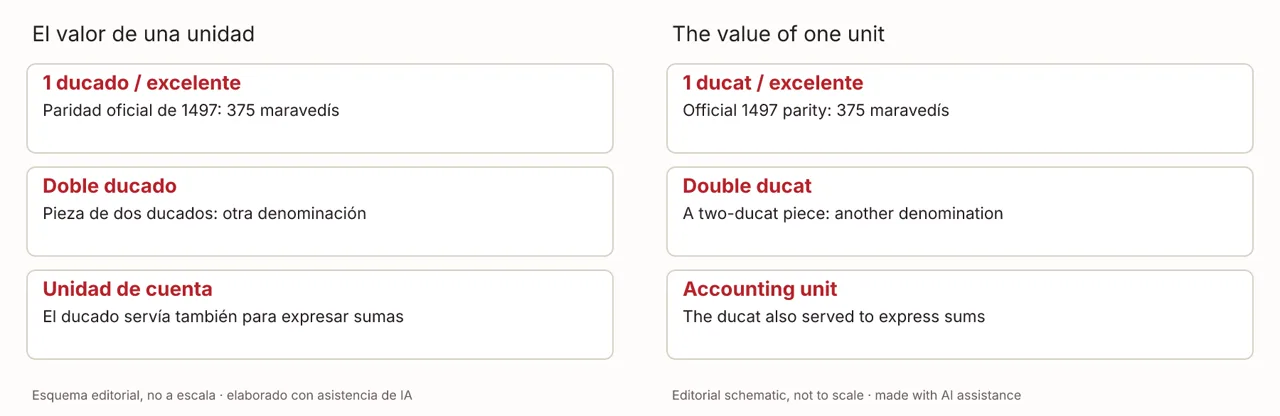
- Official parity, according to Ventura and Ramos González: one ducat or excelente de la granada, 375 maravedís.5
- Fact
- Law, according to Ventura and Ramos González: pragmatic of Medina del Campo, 13 June 1497.6
- Fact
- According to Ramos González’s text, a double ducat is a different denomination from the unit being cited.7
Which payment order also applies that parity?8
Jordi Ventura (1992) studies these equivalents in the Crown of Aragon from Inquisition records.9 On p. 496 he cites the royal order granting Fernando de Montemayor, appointed inquisitor and judge of confiscated property in Barcelona on 22 December 1497, 100,000 maravedís a year “or its value in Barcelona money, reckoning the ducat at three hundred and seventy-five maravedís” (our translation).10 He adds that, at least in Valencia, the ducat was already exchanged at 375 maravedís before the pragmatic.11

Credit: Leyenda Dorada · AI-assisted diagram based on the cited sources
Rights: Original Leyenda Dorada work. Proposed use; named-human rights admission pending.
Use in this story: AI-assisted diagram based on the cited sources, to read them more clearly; not independent proof of the events.
story-44-unit · Leyenda Dorada editorial · story-44-unit
Creator: Leyenda Dorada
Work date: 2026-10-06
Retrieved: 2026-10-06
Fernando Ramos González, in a text published by the Biblioteca Virtual Miguel de Cervantes, also gives 375 maravedís for the ducat or excelente de la granada.13 The coin illustrating that text, from the Fundación Museo de las Ferias, is a double ducat of 6.96 grams, later than 1497; according to Ramos González, pieces from a quarter to fifty ducats were struck.14
Where might Lea’s 374 come from?15
In the appendix on Spanish coinage of A History of the Inquisition of Spain (1906), Lea gives 374 maravedís for the excelente de la granada and for the ducat.16 The figure is consistent with his own reckoning: Lea says the ducat was equivalent to 11 silver reales and that the real was worth 34 maravedís, and 11 times 34 is 374.17 Against it, Ventura places the 375 parity in the pragmatic and in the 1497 order he cites, and Ramos González gives the same figure.18
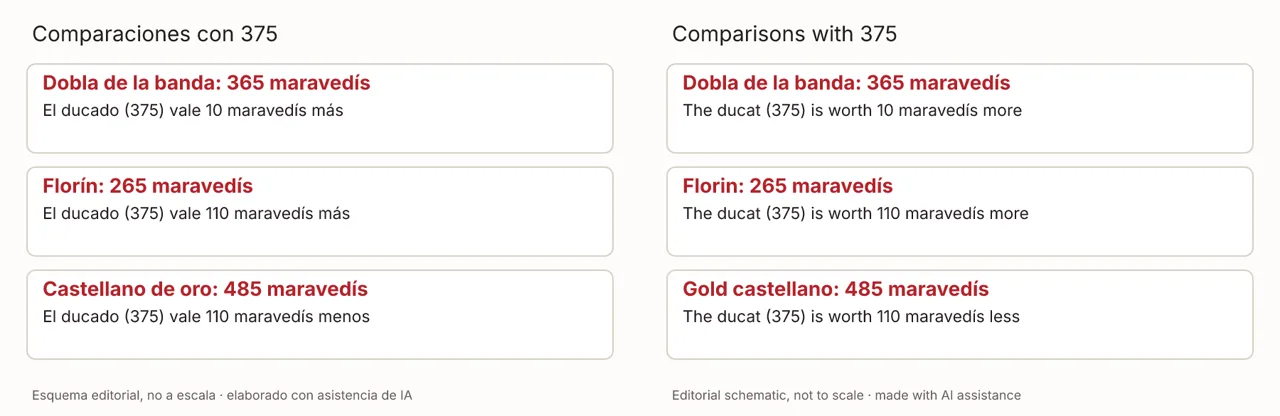
Ventura also lists the official parities of other gold coins, and Lea gives the same figures: the dobla (de la banda, in Lea), 365 maravedís; the florin, 265; the gold castellano, 485.19 At 375, the ducat is worth 10 maravedís more than the dobla de la banda, 110 more than the florin and 110 less than the gold castellano.20 These are subtractions made with those figures, not prices from historical transactions.21
Lea identifies the gold castellano with the peso de oro; for quantities of gold counted in pesos, see the gold Grijalva brought back.22

Credit: Leyenda Dorada · AI-assisted diagram based on the cited sources
Rights: Original Leyenda Dorada work. Proposed use; named-human rights admission pending.
Use in this story: AI-assisted diagram based on the cited sources, to read them more clearly; not independent proof of the events.
story-44-comparison · Leyenda Dorada editorial · story-44-comparison
Creator: Leyenda Dorada
Work date: 2026-10-06
Retrieved: 2026-10-06
Was the ducat a coin or a unit for reckoning?24
Lea calls the ducat the coin most frequently quoted, and the 1497 order uses the ducat to convert a salary fixed in maravedís into Barcelona money, where, according to Ventura, the ducat was worth 24 sueldos.25 The ducat was thus both a gold coin and a unit in which sums were expressed and converted.26 The 375 parity lets us read amounts expressed in ducats, but it does not say what they could buy, nor does it offer a conversion into present-day money.27
See also Palos, the Port Where Columbus Prepared to Set Sail.28
For silver, see Potosí silver and its guairas.29
How we know: the 375 parity comes from Ventura’s study, which cites a 1497 order, and from Ramos González’s text; 374 is the figure Lea prints.30 We have not collated the text of the pragmatic of Medina del Campo: its date and parity come from Ventura and Ramos González.31 The sources differ on the mint tally, that is, how many coins were struck from a marc of gold (65⅓ in Lea, 65⅛ in Ramos González); we do not use it in this calculation.32
- How many maravedís equalled a ducat in 1497?33
- 375 maravedís, according to Ventura and Ramos González: the official parity fixed by the pragmatic of Medina del Campo of 13 June 1497, which Ventura already finds in use in Valencia before the pragmatic.34 That parity applies to a single ducat or excelente and must be distinguished from a double-ducat piece.35
How we know
Claims cited: 35 · checked against our sources: 0 · not independently fact-checked: 35.
Inference noted in our source records: Arithmetic on the official parities given by Ventura (p. 506) and Lea (p. 560); not a statement of either source.
Inference noted in our source records: Editorial inference from the cited passages; not source quotation.
About the sources, per our source records: Proposed claim scope only; no independent canonical substantive admission. full passage read; original paraphrase; Independent research with a quoted contemporary record; archive manuscript not inspected directly; States the 375 official parity and transcribes a 22 December 1497 royal salary order using that conversion. | full passage read; original paraphrase; Independent museum object commentary; agrees on value, not used for its mint-tally figure; Identifies a double ducat specimen separately and states 375 maravedís for the ducat/excelente after the 13 June 1497 pragmatic. | Full coinage passage read; Older secondary synthesis; not the 1497 royal pragmatic; Prints 374 for the ducat/excelente and lists other gold denominations at 485,365 and 265; the 374 is contradicted by the specialist research and museum commentary.
About the sources, per our source records: Proposed claim scope only; no independent canonical substantive admission. Editorial grouping title supported by the displayed entries; not an independent source proposition. full passage read; original paraphrase; Independent research with a quoted contemporary record; archive manuscript not inspected directly; States the 375 official parity and transcribes a 22 December 1497 royal salary order using that conversion. | full passage read; original paraphrase; Independent museum object commentary; agrees on value, not used for its mint-tally figure; Identifies a double ducat specimen separately and states 375 maravedís for the ducat/excelente after the 13 June 1497 pragmatic.
About the sources, per our source records: Proposed claim scope only; no independent canonical substantive admission. full passage read; original paraphrase; Independent research with a quoted contemporary record; archive manuscript not inspected directly; States the 375 official parity and transcribes a 22 December 1497 royal salary order using that conversion. | full passage read; original paraphrase; Independent museum object commentary; agrees on value, not used for its mint-tally figure; Identifies a double ducat specimen separately and states 375 maravedís for the ducat/excelente after the 13 June 1497 pragmatic.
About the sources, per our source records: Proposed claim scope only; no independent canonical substantive admission. full passage read; original paraphrase; Independent museum object commentary; agrees on value, not used for its mint-tally figure; Identifies a double ducat specimen separately and states 375 maravedís for the ducat/excelente after the 13 June 1497 pragmatic.
About the sources, per our source records: Proposed claim scope only; no independent canonical substantive admission. Localized section label; support is the following section, not a source quotation. full passage read; original paraphrase; Independent research with a quoted contemporary record; archive manuscript not inspected directly; States the 375 official parity and transcribes a 22 December 1497 royal salary order using that conversion. | full passage read; original paraphrase; Independent museum object commentary; agrees on value, not used for its mint-tally figure; Identifies a double ducat specimen separately and states 375 maravedís for the ducat/excelente after the 13 June 1497 pragmatic.
About the sources, per our source records: Proposed claim scope only; no independent canonical substantive admission. full passage read; original paraphrase; Independent research with a quoted contemporary record; archive manuscript not inspected directly; States the 375 official parity and transcribes a 22 December 1497 royal salary order using that conversion.
About the sources, per our source records: Proposed claim scope only; no independent canonical substantive admission. Source/rights statements are supplied for human decision, not automated clearance. full passage read; original paraphrase; Independent research with a quoted contemporary record; archive manuscript not inspected directly; States the 375 official parity and transcribes a 22 December 1497 royal salary order using that conversion. | full passage read; original paraphrase; Independent museum object commentary; agrees on value, not used for its mint-tally figure; Identifies a double ducat specimen separately and states 375 maravedís for the ducat/excelente after the 13 June 1497 pragmatic. | Version preparation only; actual figure/media/rights admission pending; illustration is not independent historical evidence; Caption/attribution, not reconstruction of an eyewitness scene
About the sources, per our source records: Proposed claim scope only; no independent canonical substantive admission. Localized section label; support is the following section, not a source quotation. full passage read; original paraphrase; Independent research with a quoted contemporary record; archive manuscript not inspected directly; States the 375 official parity and transcribes a 22 December 1497 royal salary order using that conversion. | full passage read; original paraphrase; Independent museum object commentary; agrees on value, not used for its mint-tally figure; Identifies a double ducat specimen separately and states 375 maravedís for the ducat/excelente after the 13 June 1497 pragmatic. | Full coinage passage read; Older secondary synthesis; not the 1497 royal pragmatic; Prints 374 for the ducat/excelente and lists other gold denominations at 485,365 and 265; the 374 is contradicted by the specialist research and museum commentary.
About the sources, per our source records: Proposed claim scope only; no independent canonical substantive admission. Editorial contextual-navigation sentence; destination canonical identity/publication eligibility captured read-only; not independent corroboration. full passage read; original paraphrase; Independent research with a quoted contemporary record; archive manuscript not inspected directly; States the 375 official parity and transcribes a 22 December 1497 royal salary order using that conversion. | full passage read; original paraphrase; Independent museum object commentary; agrees on value, not used for its mint-tally figure; Identifies a double ducat specimen separately and states 375 maravedís for the ducat/excelente after the 13 June 1497 pragmatic. | Full coinage passage read; Older secondary synthesis; not the 1497 royal pragmatic; Prints 374 for the ducat/excelente and lists other gold denominations at 485,365 and 265; the 374 is contradicted by the specialist research and museum commentary.
About the sources, per our source records: Proposed claim scope only; no independent canonical substantive admission. Source/rights statements are supplied for human decision, not automated clearance. full passage read; original paraphrase; Independent research with a quoted contemporary record; archive manuscript not inspected directly; States the 375 official parity and transcribes a 22 December 1497 royal salary order using that conversion. | full passage read; original paraphrase; Independent museum object commentary; agrees on value, not used for its mint-tally figure; Identifies a double ducat specimen separately and states 375 maravedís for the ducat/excelente after the 13 June 1497 pragmatic. | Full coinage passage read; Older secondary synthesis; not the 1497 royal pragmatic; Prints 374 for the ducat/excelente and lists other gold denominations at 485,365 and 265; the 374 is contradicted by the specialist research and museum commentary. | Version preparation only; actual figure/media/rights admission pending; illustration is not independent historical evidence; Caption/attribution, not reconstruction of an eyewitness scene
About the sources, per our source records: Proposed claim scope only; no independent canonical substantive admission. Answer question groups the same explicit supported answer. full passage read; original paraphrase; Independent research with a quoted contemporary record; archive manuscript not inspected directly; States the 375 official parity and transcribes a 22 December 1497 royal salary order using that conversion. | full passage read; original paraphrase; Independent museum object commentary; agrees on value, not used for its mint-tally figure; Identifies a double ducat specimen separately and states 375 maravedís for the ducat/excelente after the 13 June 1497 pragmatic.
Sources
A ducat, or excelente de la granada, was worth 375 maravedís under the Medina del Campo pragmatic of 13 June 1497, and a royal order that December applies it.
not independently fact-checked primary source
Equivalencia de las monedas castellanas en la Corona de Aragón, en tiempos de Fernando el Católico; Medievalia 10 (1992), 495–514: «cuando el 22 de diciembre de 1497 el licenciado Fernando de Montemayor, arcediano de Almazán, fue nombrado inquisidor y juez de bienes confiscados en el distrito del tribunal de Barcelona, el rey ordenó que le pagasen un salario, «en cada un anyo, de cieni mil maravedís, moneda de Castilla, o su valor en moneda barcelonesa, contando a razón de trezientos setenta cinco maravedís el ducado» p. 496 and n. 2 (AHN, Inquisición, libro 242, f. 11)
Monedas de la época de los Reyes Católicos: «la de mayor trascendencia será la desarrollada por la Pragmática de Medina del Campo, fechada el 13 de junio de 1497» online text, paragraph on the Pragmática de Medina del Campo and the ducado o excelente de la granada
Henry Charles Lea gave 374 in 1906, a figure that does not match that official parity.
not independently fact-checked primary source
A History of the Inquisition of Spain, vol. I: «This coin was worth 374 maravedís and thus was practically the same as the ducat or escudo which was rated at 374.» vol. I, Appendix III "Spanish Coinage", introduction and "Gold Coins", p. 560
Equivalencia de las monedas castellanas en la Corona de Aragón, en tiempos de Fernando el Católico; Medievalia 10 (1992), 495–514: «la paridad oficial de I ducado = 375 maravedís, establecida oficialmente por la pragmática real fechada en Medina del Campo el 13 de junio de 1497» p. 496 and n. 2 (AHN, Inquisición, libro 242, f. 11)
Monedas de la época de los Reyes Católicos: «Este ducado o excelente de la granada tenía una talla de 65 ⅛ piezas por marco a un peso de ± 3'5 gramos y valor equivalente a 375 maravedís.» online text, paragraph on the Pragmática de Medina del Campo and the ducado o excelente de la granada
It applies to a single ducat, not to its multiples, and is no conversion into present-day money.
not independently fact-checked scholarly interpretation
Monedas de la época de los Reyes Católicos: «Se acuñaron piezas de un cuarto, medio, uno, dos, cinco, diez, veinte y cincuenta ducados.» online text, paragraph on the Pragmática de Medina del Campo and the ducado o excelente de la granada
Jordi Ventura, Equivalencia de las monedas castellanas en la Corona de Aragón, en tiempos de Fernando el Católico; Medievalia 10 (1992), 495–514 (1992) p. 496 and n. 2 (AHN, Inquisición, libro 242, f. 11)
The figure being compared
not independently fact-checked scholarly interpretation
Jordi Ventura, Equivalencia de las monedas castellanas en la Corona de Aragón, en tiempos de Fernando el Católico; Medievalia 10 (1992), 495–514 (1992) p. 496 and n. 2 (AHN, Inquisición, libro 242, f. 11)
Fact: Official equivalent: one ducat or excelente de la granada, 375 maravedís.
not independently fact-checked primary source
Equivalencia de las monedas castellanas en la Corona de Aragón, en tiempos de Fernando el Católico; Medievalia 10 (1992), 495–514: «la paridad oficial de I ducado = 375 maravedís, establecida oficialmente por la pragmática real fechada en Medina del Campo el 13 de junio de 1497» p. 496 and n. 2 (AHN, Inquisición, libro 242, f. 11)
Monedas de la época de los Reyes Católicos: «Este ducado o excelente de la granada tenía una talla de 65 ⅛ piezas por marco a un peso de ± 3'5 gramos y valor equivalente a 375 maravedís.» online text, paragraph on the Pragmática de Medina del Campo and the ducado o excelente de la granada
Fact: Law: pragmatic of Medina del Campo, 13 June 1497.
not independently fact-checked primary source
Equivalencia de las monedas castellanas en la Corona de Aragón, en tiempos de Fernando el Católico; Medievalia 10 (1992), 495–514: «la paridad oficial de I ducado = 375 maravedís, establecida oficialmente por la pragmática real fechada en Medina del Campo el 13 de junio de 1497» p. 496 and n. 2 (AHN, Inquisición, libro 242, f. 11)
Monedas de la época de los Reyes Católicos: «la de mayor trascendencia será la desarrollada por la Pragmática de Medina del Campo, fechada el 13 de junio de 1497» online text, paragraph on the Pragmática de Medina del Campo and the ducado o excelente de la granada
Fact: A double ducat is a different denomination from the unit being cited.
not independently fact-checked primary source
Monedas de la época de los Reyes Católicos: «Doble ducado o doble excelente de la granada Sevilla - hoja de parra. Posterior a 1497. Oro / 27 mm. diámetro, 6'96 g. Fundación Museo de las Ferias.» online text, object entry "Doble ducado o doble excelente de la granada" (Fundación Museo de las Ferias)
Monedas de la época de los Reyes Católicos: «Se acuñaron piezas de un cuarto, medio, uno, dos, cinco, diez, veinte y cincuenta ducados.» online text, paragraph on the Pragmática de Medina del Campo and the ducado o excelente de la granada
The equivalence also appears in a payment order
not independently fact-checked scholarly interpretation
Jordi Ventura, Equivalencia de las monedas castellanas en la Corona de Aragón, en tiempos de Fernando el Católico; Medievalia 10 (1992), 495–514 (1992) p. 496 and n. 2 (AHN, Inquisición, libro 242, f. 11)
Jordi Ventura (1992) studies these equivalents in the Crown of Aragon from Inquisition records.
not independently fact-checked primary source
Equivalencia de las monedas castellanas en la Corona de Aragón, en tiempos de Fernando el Católico; Medievalia 10 (1992), 495–514: «tomando como fuente de base la documentación inquisitorial y la práctica mercantil de la época» pp. 495–496 (introduction: sources and method)
On p. 496 he cites the royal order granting Fernando de Montemayor, appointed inquisitor and judge of confiscated property in Barcelona on 22 December 1497, 100,000 maravedís a year “or its value in Barcelona money, reckoning the ducat at three hundred and seventy-five maravedís” (our translation).
not independently fact-checked primary source
Equivalencia de las monedas castellanas en la Corona de Aragón, en tiempos de Fernando el Católico; Medievalia 10 (1992), 495–514: «cuando el 22 de diciembre de 1497 el licenciado Fernando de Montemayor, arcediano de Almazán, fue nombrado inquisidor y juez de bienes confiscados en el distrito del tribunal de Barcelona, el rey ordenó que le pagasen un salario, «en cada un anyo, de cieni mil maravedís, moneda de Castilla, o su valor en moneda barcelonesa, contando a razón de trezientos setenta cinco maravedís el ducado» p. 496 and n. 2 (AHN, Inquisición, libro 242, f. 11)
He adds that, at least in Valencia, the ducat was already exchanged at 375 maravedís before the pragmatic, in a payment of March 1496.
not independently fact-checked primary source
Equivalencia de las monedas castellanas en la Corona de Aragón, en tiempos de Fernando el Católico; Medievalia 10 (1992), 495–514: «Ya antes del decrelo real de 1497, el cambio del ducado se efectuaba sobre la base de una paridad de 375 ms. Por lo menos era así en Valencia» p. 497 (parity of 375 before the 1497 decree; Valencia, 17 March 1496)
Editorial schematic, not to scale; made with AI assistance from the cited sources. It represents accounting units; the drawn shapes are neither photographs nor reproductions of historical coins.
not independently fact-checked scholarly interpretation
Leyenda Dorada, story-44-unit unit-guide; exact full-frame image and supplied provenance/rights
Jordi Ventura, Equivalencia de las monedas castellanas en la Corona de Aragón, en tiempos de Fernando el Católico; Medievalia 10 (1992), 495–514 (1992) p. 496 and n. 2 (AHN, Inquisición, libro 242, f. 11)
Fernando Ramos González, Monedas de la época de los Reyes Católicos online text, object entry "Doble ducado o doble excelente de la granada" (Fundación Museo de las Ferias)
Fernando Ramos González, in a text published by the Biblioteca Virtual Miguel de Cervantes and illustrated with coins from the Fundación Museo de las Ferias, also gives 375 maravedís for the ducat or excelente de la granada.
not independently fact-checked primary source
Monedas de la época de los Reyes Católicos: «Monedas de la época de los Reyes Católicos Fernando Ramos González» online text, heading, signature and "Bibliografía"
Monedas de la época de los Reyes Católicos: «Este ducado o excelente de la granada tenía una talla de 65 ⅛ piezas por marco a un peso de ± 3'5 gramos y valor equivalente a 375 maravedís.» online text, paragraph on the Pragmática de Medina del Campo and the ducado o excelente de la granada
The coin illustrating that text is a double ducat of 6.96 grams, later than 1497: one of the multiples that were struck, from a quarter to fifty ducats.
not independently fact-checked primary source
Monedas de la época de los Reyes Católicos: «Doble ducado o doble excelente de la granada Sevilla - hoja de parra. Posterior a 1497. Oro / 27 mm. diámetro, 6'96 g. Fundación Museo de las Ferias.» online text, object entry "Doble ducado o doble excelente de la granada" (Fundación Museo de las Ferias)
Monedas de la época de los Reyes Católicos: «Se acuñaron piezas de un cuarto, medio, uno, dos, cinco, diez, veinte y cincuenta ducados.» online text, paragraph on the Pragmática de Medina del Campo and the ducado o excelente de la granada
Why Lea gives 374
not independently fact-checked scholarly interpretation
Henry Charles Lea, A History of the Inquisition of Spain, vol. I (1906) vol. I, Appendix III "Spanish Coinage", introduction and "Gold Coins", p. 560
In the appendix on Spanish coinage of his History of the Inquisition of Spain (1906), Lea gives 374 maravedís for the excelente de la granada and for the ducat.
not independently fact-checked primary source
A History of the Inquisition of Spain, vol. I: «This coin was worth 374 maravedís and thus was practically the same as the ducat or escudo which was rated at 374.» vol. I, Appendix III "Spanish Coinage", introduction and "Gold Coins", p. 560
The figure is consistent with his own reckoning: Lea says the ducat was equivalent to 11 silver reales and that the real was worth 34 maravedís, and 11 times 34 is 374.
not independently fact-checked scholarly interpretation
A History of the Inquisition of Spain, vol. I: «Thus the ducat, which was the coin most frequently quoted, was equivalent to 11 silver reales.» vol. I, Appendix III "Spanish Coinage", introduction and "Gold Coins", p. 560
Against it, the 375 parity rests on the pragmatic and on the 1497 order Ventura cites, and Ramos González gives the same figure.
not independently fact-checked scholarly interpretation
Equivalencia de las monedas castellanas en la Corona de Aragón, en tiempos de Fernando el Católico; Medievalia 10 (1992), 495–514: «la paridad oficial de I ducado = 375 maravedís, establecida oficialmente por la pragmática real fechada en Medina del Campo el 13 de junio de 1497» p. 496 and n. 2 (AHN, Inquisición, libro 242, f. 11)
Monedas de la época de los Reyes Católicos: «Este ducado o excelente de la granada tenía una talla de 65 ⅛ piezas por marco a un peso de ± 3'5 gramos y valor equivalente a 375 maravedís.» online text, paragraph on the Pragmática de Medina del Campo and the ducado o excelente de la granada
Lea and Ventura also list the official parities of other gold coins: the dobla (de la banda, in Lea), 365 maravedís; the florin, 265; the gold castellano, 485.
not independently fact-checked primary source
A History of the Inquisition of Spain, vol. I: «There were also the dobla alfonsi or castellano or peso de oro , equal to 485, the dobla de la banda to 365, the florin to 265.» vol. I, Appendix III "Spanish Coinage", introduction and "Gold Coins", p. 560
Equivalencia de las monedas castellanas en la Corona de Aragón, en tiempos de Fernando el Católico; Medievalia 10 (1992), 495–514: «Las equivalencias en maravedís, establecidas oficialmente, eran: ID 1 Fl 1C 1 Dobla (Db.) . . Ir 375 ms. 265 ms. 485 ms. 365 ms. 34 ms.» p. 506, "De las paridades reales de las monedas castellanas en la Corona de Aragón" (table of official parities)
At 375, the ducat is worth 10 maravedís more than the dobla de la banda, 110 more than the florin and 110 less than the gold castellano.
not independently fact-checked inference
Jordi Ventura, Equivalencia de las monedas castellanas en la Corona de Aragón, en tiempos de Fernando el Católico; Medievalia 10 (1992), 495–514 (1992) p. 506, "De las paridades reales de las monedas castellanas en la Corona de Aragón" (table of official parities)
Henry Charles Lea, A History of the Inquisition of Spain, vol. I (1906) vol. I, Appendix III "Spanish Coinage", introduction and "Gold Coins", p. 560
These are subtractions made with those official values, not prices from historical transactions.
not independently fact-checked inference
Jordi Ventura, Equivalencia de las monedas castellanas en la Corona de Aragón, en tiempos de Fernando el Católico; Medievalia 10 (1992), 495–514 (1992) p. 506, "De las paridades reales de las monedas castellanas en la Corona de Aragón" (table of official parities)
For quantities of gold counted in pesos, see the gold Grijalva brought back.
not independently fact-checked scholarly interpretation
Henry Charles Lea, A History of the Inquisition of Spain, vol. I (1906) vol. I, Appendix III "Spanish Coinage", introduction and "Gold Coins", p. 560
Editorial schematic, not to scale; made with AI assistance from the cited sources. Present-day subtractions between the ducat’s official parity, 375 maravedís, and those of the dobla de la banda, the florin and the gold castellano given by Lea and Ventura; these are not market prices.
not independently fact-checked scholarly interpretation
Leyenda Dorada, story-44-comparison arithmetic-guide; exact full-frame image and supplied provenance/rights
Jordi Ventura, Equivalencia de las monedas castellanas en la Corona de Aragón, en tiempos de Fernando el Católico; Medievalia 10 (1992), 495–514 (1992) p. 506, "De las paridades reales de las monedas castellanas en la Corona de Aragón" (table of official parities)
Henry Charles Lea, A History of the Inquisition of Spain, vol. I (1906) vol. I, Appendix III "Spanish Coinage", introduction and "Gold Coins", p. 560
A coin and a unit for reckoning
not independently fact-checked scholarly interpretation
Henry Charles Lea, A History of the Inquisition of Spain, vol. I (1906) vol. I, Appendix III "Spanish Coinage", introduction and "Gold Coins", p. 560
Lea calls the ducat the coin most frequently quoted, and in the 1497 order it is the step for converting a salary fixed in maravedís into Barcelona money, where the ducat was worth 24 sueldos.
not independently fact-checked primary source
A History of the Inquisition of Spain, vol. I: «Thus the ducat, which was the coin most frequently quoted, was equivalent to 11 silver reales.» vol. I, Appendix III "Spanish Coinage", introduction and "Gold Coins", p. 560
Equivalencia de las monedas castellanas en la Corona de Aragón, en tiempos de Fernando el Católico; Medievalia 10 (1992), 495–514: «cuando el 22 de diciembre de 1497 el licenciado Fernando de Montemayor, arcediano de Almazán, fue nombrado inquisidor y juez de bienes confiscados en el distrito del tribunal de Barcelona, el rey ordenó que le pagasen un salario, «en cada un anyo, de cieni mil maravedís, moneda de Castilla, o su valor en moneda barcelonesa, contando a razón de trezientos setenta cinco maravedís el ducado» p. 496 and n. 2 (AHN, Inquisición, libro 242, f. 11)
The ducat was thus both a gold coin and a unit in which sums were expressed and converted.
not independently fact-checked scholarly interpretation
Henry Charles Lea, A History of the Inquisition of Spain, vol. I (1906) vol. I, Appendix III "Spanish Coinage", introduction and "Gold Coins", p. 560
Jordi Ventura, Equivalencia de las monedas castellanas en la Corona de Aragón, en tiempos de Fernando el Católico; Medievalia 10 (1992), 495–514 (1992) p. 496 and n. 2 (AHN, Inquisición, libro 242, f. 11)
Its equivalent lets us read amounts expressed in ducats, but it does not say what they could buy, nor does it offer a conversion into present-day money.
not independently fact-checked scholarly interpretation
Jordi Ventura, Equivalencia de las monedas castellanas en la Corona de Aragón, en tiempos de Fernando el Católico; Medievalia 10 (1992), 495–514 (1992) p. 496 and n. 2 (AHN, Inquisición, libro 242, f. 11)
A sum from 1492 expressed in maravedís appears in Santángel’s loan for the Palos ships.
not independently fact-checked scholarly interpretation
Jordi Ventura, Equivalencia de las monedas castellanas en la Corona de Aragón, en tiempos de Fernando el Católico; Medievalia 10 (1992), 495–514 (1992) p. 496 and n. 2 (AHN, Inquisición, libro 242, f. 11)
For silver, the other metal of Castilian coinage, see Potosí silver and its guairas.
not independently fact-checked scholarly interpretation
Henry Charles Lea, A History of the Inquisition of Spain, vol. I (1906) vol. I, Appendix III "Spanish Coinage", introduction and "Gold Coins", p. 560
How we know: the 375 parity comes from Ventura’s study, which cites a 1497 order in the Archivo Histórico Nacional, and from Ramos González’s text; 374 is the figure Lea prints.
not independently fact-checked scholarly interpretation
Jordi Ventura, Equivalencia de las monedas castellanas en la Corona de Aragón, en tiempos de Fernando el Católico; Medievalia 10 (1992), 495–514 (1992) p. 496 and n. 2 (AHN, Inquisición, libro 242, f. 11)
Fernando Ramos González, Monedas de la época de los Reyes Católicos online text, paragraph on the Pragmática de Medina del Campo and the ducado o excelente de la granada
Henry Charles Lea, A History of the Inquisition of Spain, vol. I (1906) vol. I, Appendix III "Spanish Coinage", introduction and "Gold Coins", p. 560
We have not collated the text of the pragmatic of Medina del Campo: its date and parity come from Ventura and Ramos González.
not independently fact-checked scholarly interpretation
Jordi Ventura, Equivalencia de las monedas castellanas en la Corona de Aragón, en tiempos de Fernando el Católico; Medievalia 10 (1992), 495–514 (1992) p. 496 and n. 2 (AHN, Inquisición, libro 242, f. 11)
Fernando Ramos González, Monedas de la época de los Reyes Católicos online text, paragraph on the Pragmática de Medina del Campo and the ducado o excelente de la granada
The sources differ on the mint tally, that is, how many coins were struck from a marc of gold (65⅓ in Lea, 65⅛ in Ramos González); we do not use it in this calculation.
not independently fact-checked primary source
A History of the Inquisition of Spain, vol. I: «they ordered the marc to be worked into 65⅓ excelentes de la granada» vol. I, Appendix III "Spanish Coinage", introduction and "Gold Coins", p. 560
Monedas de la época de los Reyes Católicos: «Este ducado o excelente de la granada tenía una talla de 65 ⅛ piezas por marco a un peso de ± 3'5 gramos y valor equivalente a 375 maravedís.» online text, paragraph on the Pragmática de Medina del Campo and the ducado o excelente de la granada
How many maravedís equalled a ducat in 1497?
not independently fact-checked scholarly interpretation
Jordi Ventura, Equivalencia de las monedas castellanas en la Corona de Aragón, en tiempos de Fernando el Católico; Medievalia 10 (1992), 495–514 (1992) p. 496 and n. 2 (AHN, Inquisición, libro 242, f. 11)
375 maravedís: the official parity fixed by the pragmatic of Medina del Campo of 13 June 1497, which Ventura already finds in use in Valencia in 1496.
not independently fact-checked primary source
Equivalencia de las monedas castellanas en la Corona de Aragón, en tiempos de Fernando el Católico; Medievalia 10 (1992), 495–514: «la paridad oficial de I ducado = 375 maravedís, establecida oficialmente por la pragmática real fechada en Medina del Campo el 13 de junio de 1497» p. 496 and n. 2 (AHN, Inquisición, libro 242, f. 11)
Monedas de la época de los Reyes Católicos: «la de mayor trascendencia será la desarrollada por la Pragmática de Medina del Campo, fechada el 13 de junio de 1497» online text, paragraph on the Pragmática de Medina del Campo and the ducado o excelente de la granada
Equivalencia de las monedas castellanas en la Corona de Aragón, en tiempos de Fernando el Católico; Medievalia 10 (1992), 495–514: «Ya antes del decrelo real de 1497, el cambio del ducado se efectuaba sobre la base de una paridad de 375 ms. Por lo menos era así en Valencia» p. 497 (parity of 375 before the 1497 decree; Valencia, 17 March 1496)
That equivalent concerns one ducat or excelente unit and must be distinguished from a double-ducat piece.
not independently fact-checked primary source
Equivalencia de las monedas castellanas en la Corona de Aragón, en tiempos de Fernando el Católico; Medievalia 10 (1992), 495–514: «la paridad oficial de I ducado = 375 maravedís, establecida oficialmente por la pragmática real fechada en Medina del Campo el 13 de junio de 1497» p. 496 and n. 2 (AHN, Inquisición, libro 242, f. 11)
Monedas de la época de los Reyes Católicos: «Doble ducado o doble excelente de la granada Sevilla - hoja de parra. Posterior a 1497. Oro / 27 mm. diámetro, 6'96 g. Fundación Museo de las Ferias.» online text, object entry "Doble ducado o doble excelente de la granada" (Fundación Museo de las Ferias)
Monedas de la época de los Reyes Católicos: «Se acuñaron piezas de un cuarto, medio, uno, dos, cinco, diez, veinte y cincuenta ducados.» online text, paragraph on the Pragmática de Medina del Campo and the ducado o excelente de la granada
leyenda-dorada · https://leyendadorada.com/en/stories/excelente-de-la-granada-value-1497 · accessed November 22, 2026