Stories
When Diego de Almagro the Elder Died: 1538 and Guaman Poma’s 1541

People and documents4
What does the amendment to Guaman Poma’s heading change?8
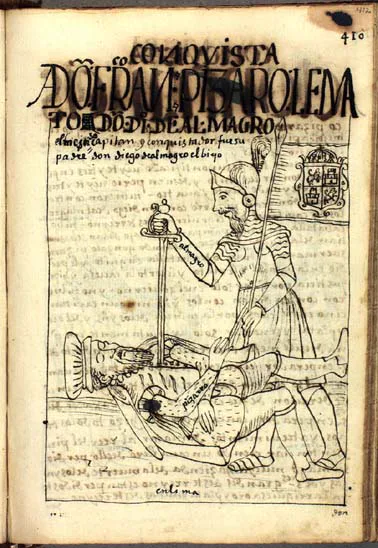
Guaman Poma’s image and prose need to be read together.9 In the initial version, Francisco Pizarro appears as the man who kills Diego de Almagro.10 A note added in 2004 by the digital edition’s editors, Rolena Adorno and Ivan Boserup, records the author’s own amendment: the mestizo Almagro becomes the aggressor and Pizarro the victim.11 The drawing’s amended heading puts it plainly: “Don Francisco Pizarro was killed by don Diego de Almagro, the mestizo. His father was don Diego de Almagro the elder” (our translation).12

Credit: Felipe Guaman Poma de Ayala — Royal Danish Library, GKS 2232 4º
Rights: Public Domain Mark 1.0 (Royal Danish Library). Named-human rights admission pending.
Use in this story: Drawing from Guaman Poma’s chronicle, shown as a later representation and not as independent proof of the events.
Nueva corónica y buen gobierno, dibujo 165 (p. 410 [412]) · Royal Danish Library, GKS2232 4º · gp-412
Creator: Felipe Guaman Poma de Ayala
Work date: c.1615
Retrieved: 2026-10-06
The amendment left uncancelled the words “capitán general y conquistador deste rreyno”, which, according to the note, refer to Almagro the elder.14 The paragraph dated 1541 mixes episodes: a battle at Yauri Pampa near Cuzco, Gonzalo Pizarro’s help, “otra batalla en Quito” and a beheading.15 Dating the father’s death to 1541 from the initial version would perpetuate a confusion that the edition makes visible.16
On the same page Guaman Poma judges that those captains fought not the Indians but “among themselves, out of greed for the Indians and for gold and silver”, and condemns the pride of the man who, sent as the emperor’s ambassador, dared “to kill the king of Peru, Atahualpa Inca” (our translation).17 It is the author’s verdict on the wars among the conquerors, not a dated chronicle of each battle.18
When did Almagro the elder die, and in which wars did his son act?19
Memoria Chilena’s chronology places the execution of Almagro the elder on 8 July 1538 and attributes it to an order from Hernando Pizarro.20 Prescott, a nineteenth-century historian, dates the close of the trial to 8 July 1538 and relates that Almagro was garrotted in his Cuzco prison and his head then cut off in the square.21 That dating places the father’s death three years before the events of 1541.22
Prescott reports that Francisco Pizarro is said to have been asked by Hernando what to do with the prisoner and to have answered “Deal with him so that he shall give us no more trouble”; he concludes that history must hold Francisco “equally accountable” with Hernando for the death of his associate.23
Another story about Pizarro and Almagro is examined in Pizarro and Almagro: Aid on Gorgona and Fears over the Coast.24
Introducing his account of the civil wars, Cieza announces the conspiracy that “those of Chile”, the Adelantado’s followers, formed in the City of the Kings (Lima) to kill the marquis Francisco Pizarro, and how the son had himself accepted as governor across most of the kingdom.25 According to Prescott, the day named for that assassination was Sunday 26 June 1541, the year of Guaman Poma’s paragraph.26 Cieza then mentions the “cruel battle of Chupas” and the beheading of the young Almagro on the orders of governor Vaca de Castro.27 Cieza’s outline orders successive conflicts, not a single battle.28
Manco Inca’s retreat is examined in Manco Inca and Vilcabamba: from retreat to the account of his death.29

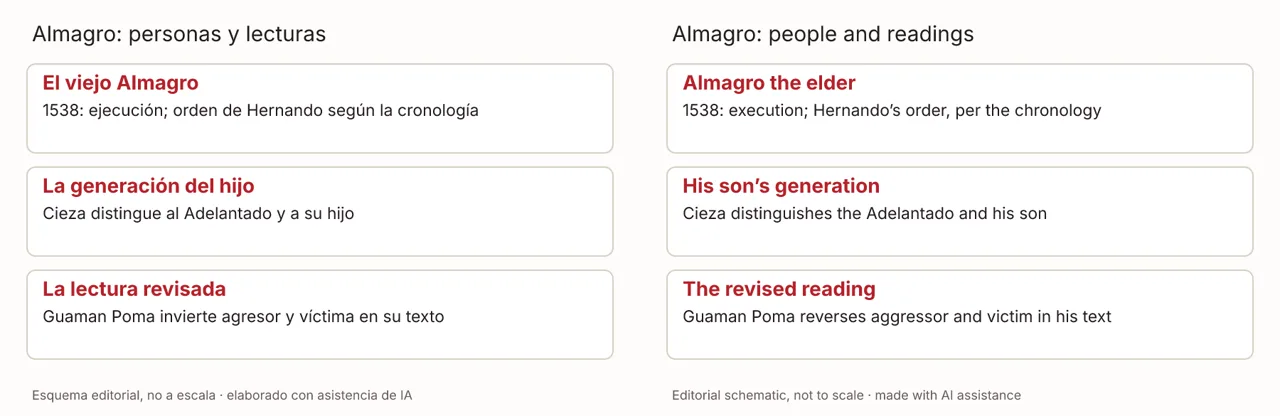
Credit: Leyenda Dorada · AI-assisted diagram based on the cited sources
Rights: Original Leyenda Dorada work. Proposed use; named-human rights admission pending.
Use in this story: AI-assisted diagram based on the cited sources, to read them more clearly; not independent proof of the events.
story-13-comparison · Leyenda Dorada editorial · story-13-comparison
Creator: Leyenda Dorada
Work date: 2026-10-06
Retrieved: 2026-10-06
Who founded Trujillo, and when?31
Two foundation dates are proposed for Trujillo, and one credits Almagro the elder.32 A 2016 news item from the La Libertad office of Peru’s Ministry of Culture summarises a symposium: for Raúl Porras Barrenechea, Pizarro officially founded it on 5 March 1535, after Lima.33 For Jorge Zevallos Quiñones, Diego de Almagro founded it in late November 1534; Pizarro only came in 1535 to distribute house plots and encomiendas to the 31 vecinos.34 The closing talk of the symposium is titled “De Raúl Porras a Jorge Zevallos: Argumentos para una discusión sin fin” (“from Raúl Porras to Jorge Zevallos: arguments for a discussion without end”, our translation): what is disputed is who founded Trujillo, and when.35
Other foundations attributed to Pizarro are examined in Francisco Pizarro: what the sources say about the places in his story.36
How we know: we combine the manuscript and its editors’ notes with Memoria Chilena’s chronology, Cieza’s outline and Prescott’s history.37 These sources allow the people and dates mixed in the 1541 paragraph to be told apart.38 We have not collated the original records of the 1538 trial or of Trujillo’s foundation.39
- When did Diego de Almagro the elder die: 1538 or 1541?40
- He died in 1538, according to the Memoria Chilena chronology; Prescott narrates his execution in the Cuzco prison after a process closed on 8 July that year.4121 Guaman Poma dates his paragraph to 1541, the year for which, according to Prescott, the assassination of Francisco Pizarro was fixed; the page carries an amended heading.42
- What does Guaman Poma’s revision change?43
- In the initial version, Francisco Pizarro appears as the one who kills Diego de Almagro.44 The digital edition’s editors record an amendment by the author himself: the mestizo Almagro becomes the aggressor and Pizarro the victim.45 The amendment left uncancelled “capitán general y conquistador deste rreyno”, words that, according to the note, refer to Almagro the elder.46
- How do the sources tell the two Almagros apart?47
- According to Memoria Chilena’s chronology, Almagro the elder was executed in 1538 on Hernando Pizarro’s order; the younger is, according to Cieza, the Adelantado’s son.48 That date places the father’s death three years before 1541, and the historian Prescott holds Francisco “equally accountable” with Hernando for the death of his associate.4923
How we know
Claims cited: 49 · checked against our sources: 0 · not independently fact-checked: 49.
About the sources, per our source records: Proposed claim scope only; no independent canonical substantive admission. full passage read; original paraphrase; same author as story; primary source check, not independent corroboration; The original prose assigns the killing to Pizarro in 1541. Editorial note 1 records the author’s later reversal and the unremoved description referring to Almagro the elder. | full passage read; original paraphrase; Expert manuscript interpretation; same edition, not a separate historical witness; The corrected and uncorrected readings have different subjects and objects; the print facsimile also intervened in the reading. | Full page and relevant chronology entry read; Independent institutional synthesis, not the original execution record; Confirms elder Almagro’s 1538 death and Hernando Pizarro’s responsibility; do not use its conflicting Las Salinas day. | OCR surrounding passage read; critical transcription requires scan collation; Different colonial author; book outline rather than a complete battle record; Identifies the younger Diego as son of the Adelantado; separates the killing of Francisco Pizarro by the elder’s followers from the younger’s later defeat at Chupas.
About the sources, per our source records: Proposed claim scope only; no independent canonical substantive admission. Editorial grouping title supported by the displayed entries; not an independent source proposition. Full page and relevant chronology entry read; Independent institutional synthesis, not the original execution record; Confirms elder Almagro’s 1538 death and Hernando Pizarro’s responsibility; do not use its conflicting Las Salinas day. | OCR surrounding passage read; critical transcription requires scan collation; Different colonial author; book outline rather than a complete battle record; Identifies the younger Diego as son of the Adelantado; separates the killing of Francisco Pizarro by the elder’s followers from the younger’s later defeat at Chupas. | full passage read; original paraphrase; same author as story; primary source check, not independent corroboration; The drawing caption is transcribed in its original form; editorial note 1 gives the amended reading in which Almagro the mestizo killed Francisco Pizarro. | full passage read; original paraphrase; same author as story; primary source check, not independent corroboration; The original prose assigns the killing to Pizarro in 1541. Editorial note 1 records the author’s later reversal and the unremoved description referring to Almagro the elder. | full passage read; original paraphrase; Expert manuscript interpretation; same edition, not a separate historical witness; The corrected and uncorrected readings have different subjects and objects; the print facsimile also intervened in the reading.
About the sources, per our source records: Proposed claim scope only; no independent canonical substantive admission. Full page and relevant chronology entry read; Independent institutional synthesis, not the original execution record; Confirms elder Almagro’s 1538 death and Hernando Pizarro’s responsibility; do not use its conflicting Las Salinas day.
About the sources, per our source records: Proposed claim scope only; no independent canonical substantive admission. OCR surrounding passage read; critical transcription requires scan collation; Different colonial author; book outline rather than a complete battle record; Identifies the younger Diego as son of the Adelantado; separates the killing of Francisco Pizarro by the elder’s followers from the younger’s later defeat at Chupas.
About the sources, per our source records: Proposed claim scope only; no independent canonical substantive admission. full passage read; original paraphrase; same author as story; primary source check, not independent corroboration; The drawing caption is transcribed in its original form; editorial note 1 gives the amended reading in which Almagro the mestizo killed Francisco Pizarro. | full passage read; original paraphrase; same author as story; primary source check, not independent corroboration; The original prose assigns the killing to Pizarro in 1541. Editorial note 1 records the author’s later reversal and the unremoved description referring to Almagro the elder. | full passage read; original paraphrase; Expert manuscript interpretation; same edition, not a separate historical witness; The corrected and uncorrected readings have different subjects and objects; the print facsimile also intervened in the reading.
About the sources, per our source records: Proposed claim scope only; no independent canonical substantive admission. Localized section label; support is the following section, not a source quotation. full passage read; original paraphrase; same author as story; primary source check, not independent corroboration; The drawing caption is transcribed in its original form; editorial note 1 gives the amended reading in which Almagro the mestizo killed Francisco Pizarro. | full passage read; original paraphrase; same author as story; primary source check, not independent corroboration; The original prose assigns the killing to Pizarro in 1541. Editorial note 1 records the author’s later reversal and the unremoved description referring to Almagro the elder. | full passage read; original paraphrase; Expert manuscript interpretation; same edition, not a separate historical witness; The corrected and uncorrected readings have different subjects and objects; the print facsimile also intervened in the reading.
About the sources, per our source records: Proposed claim scope only; no independent canonical substantive admission. Source/rights statements are supplied for human decision, not automated clearance. full passage read; original paraphrase; same author as story; primary source check, not independent corroboration; The drawing caption is transcribed in its original form; editorial note 1 gives the amended reading in which Almagro the mestizo killed Francisco Pizarro. | full passage read; original paraphrase; Expert manuscript interpretation; same edition, not a separate historical witness; The corrected and uncorrected readings have different subjects and objects; the print facsimile also intervened in the reading. | Version preparation only; actual figure/media/rights admission pending; illustration is not independent historical evidence; Caption/attribution, not reconstruction of an eyewitness scene
About the sources, per our source records: Proposed claim scope only; no independent canonical substantive admission. full passage read; original paraphrase; same author as story; primary source check, not independent corroboration; The original prose assigns the killing to Pizarro in 1541. Editorial note 1 records the author’s later reversal and the unremoved description referring to Almagro the elder. | full passage read; original paraphrase; Expert manuscript interpretation; same edition, not a separate historical witness; The corrected and uncorrected readings have different subjects and objects; the print facsimile also intervened in the reading.
About the sources, per our source records: Proposed claim scope only; no independent canonical substantive admission. Localized section label; support is the following section, not a source quotation. Full page and relevant chronology entry read; Independent institutional synthesis, not the original execution record; Confirms elder Almagro’s 1538 death and Hernando Pizarro’s responsibility; do not use its conflicting Las Salinas day. | OCR surrounding passage read; critical transcription requires scan collation; Different colonial author; book outline rather than a complete battle record; Identifies the younger Diego as son of the Adelantado; separates the killing of Francisco Pizarro by the elder’s followers from the younger’s later defeat at Chupas. | full passage read; original paraphrase; same author as story; primary source check, not independent corroboration; The original prose assigns the killing to Pizarro in 1541. Editorial note 1 records the author’s later reversal and the unremoved description referring to Almagro the elder. | full passage read; original paraphrase; Expert manuscript interpretation; same edition, not a separate historical witness; The corrected and uncorrected readings have different subjects and objects; the print facsimile also intervened in the reading.
About the sources, per our source records: Proposed claim scope only; no independent canonical substantive admission. Editorial contextual-navigation sentence; destination canonical identity/publication eligibility captured read-only; not independent corroboration. Full page and relevant chronology entry read; Independent institutional synthesis, not the original execution record; Confirms elder Almagro’s 1538 death and Hernando Pizarro’s responsibility; do not use its conflicting Las Salinas day.
About the sources, per our source records: Proposed claim scope only; no independent canonical substantive admission. Editorial contextual-navigation sentence; destination canonical identity/publication eligibility captured read-only; not independent corroboration. OCR surrounding passage read; critical transcription requires scan collation; Different colonial author; book outline rather than a complete battle record; Identifies the younger Diego as son of the Adelantado; separates the killing of Francisco Pizarro by the elder’s followers from the younger’s later defeat at Chupas.
About the sources, per our source records: Proposed claim scope only; no independent canonical substantive admission. Source/rights statements are supplied for human decision, not automated clearance. full passage read; original paraphrase; same author as story; primary source check, not independent corroboration; The original prose assigns the killing to Pizarro in 1541. Editorial note 1 records the author’s later reversal and the unremoved description referring to Almagro the elder. | full passage read; original paraphrase; Expert manuscript interpretation; same edition, not a separate historical witness; The corrected and uncorrected readings have different subjects and objects; the print facsimile also intervened in the reading. | Full page and relevant chronology entry read; Independent institutional synthesis, not the original execution record; Confirms elder Almagro’s 1538 death and Hernando Pizarro’s responsibility; do not use its conflicting Las Salinas day. | OCR surrounding passage read; critical transcription requires scan collation; Different colonial author; book outline rather than a complete battle record; Identifies the younger Diego as son of the Adelantado; separates the killing of Francisco Pizarro by the elder’s followers from the younger’s later defeat at Chupas. | Version preparation only; actual figure/media/rights admission pending; illustration is not independent historical evidence; Caption/attribution, not reconstruction of an eyewitness scene
About the sources, per our source records: Proposed claim scope only; no independent canonical substantive admission. Localized section label; support is the following section, not a source quotation. full passage read; original paraphrase; Independent institutional report of historical research; underlying letters not yet inspected; Reports competing foundation arguments: Almagro in late 1534 and Pizarro’s official foundation on 5 March 1535. Neither supports 1503. | full passage read; original paraphrase; same author as story; primary source check, not independent corroboration; The original prose assigns the killing to Pizarro in 1541. Editorial note 1 records the author’s later reversal and the unremoved description referring to Almagro the elder. | full passage read; original paraphrase; Expert manuscript interpretation; same edition, not a separate historical witness; The corrected and uncorrected readings have different subjects and objects; the print facsimile also intervened in the reading. | Full page and relevant chronology entry read; Independent institutional synthesis, not the original execution record; Confirms elder Almagro’s 1538 death and Hernando Pizarro’s responsibility; do not use its conflicting Las Salinas day. | OCR surrounding passage read; critical transcription requires scan collation; Different colonial author; book outline rather than a complete battle record; Identifies the younger Diego as son of the Adelantado; separates the killing of Francisco Pizarro by the elder’s followers from the younger’s later defeat at Chupas.
About the sources, per our source records: Proposed claim scope only; no independent canonical substantive admission. full passage read; original paraphrase; Independent institutional report of historical research; underlying letters not yet inspected; Reports competing foundation arguments: Almagro in late 1534 and Pizarro’s official foundation on 5 March 1535. Neither supports 1503.
About the sources, per our source records: Proposed claim scope only; no independent canonical substantive admission. Editorial contextual-navigation sentence; destination canonical identity/publication eligibility captured read-only; not independent corroboration. full passage read; original paraphrase; Independent institutional report of historical research; underlying letters not yet inspected; Reports competing foundation arguments: Almagro in late 1534 and Pizarro’s official foundation on 5 March 1535. Neither supports 1503.
About the sources, per our source records: Proposed claim scope only; no independent canonical substantive admission. full passage read; original paraphrase; same author as story; primary source check, not independent corroboration; The original prose assigns the killing to Pizarro in 1541. Editorial note 1 records the author’s later reversal and the unremoved description referring to Almagro the elder. | full passage read; original paraphrase; Expert manuscript interpretation; same edition, not a separate historical witness; The corrected and uncorrected readings have different subjects and objects; the print facsimile also intervened in the reading. | full passage read; original paraphrase; Independent institutional report of historical research; underlying letters not yet inspected; Reports competing foundation arguments: Almagro in late 1534 and Pizarro’s official foundation on 5 March 1535. Neither supports 1503. | Full page and relevant chronology entry read; Independent institutional synthesis, not the original execution record; Confirms elder Almagro’s 1538 death and Hernando Pizarro’s responsibility; do not use its conflicting Las Salinas day. | OCR surrounding passage read; critical transcription requires scan collation; Different colonial author; book outline rather than a complete battle record; Identifies the younger Diego as son of the Adelantado; separates the killing of Francisco Pizarro by the elder’s followers from the younger’s later defeat at Chupas.
About the sources, per our source records: Proposed claim scope only; no independent canonical substantive admission. Answer question groups the same explicit supported answer. full passage read; original paraphrase; same author as story; primary source check, not independent corroboration; The original prose assigns the killing to Pizarro in 1541. Editorial note 1 records the author’s later reversal and the unremoved description referring to Almagro the elder. | full passage read; original paraphrase; Expert manuscript interpretation; same edition, not a separate historical witness; The corrected and uncorrected readings have different subjects and objects; the print facsimile also intervened in the reading. | Full page and relevant chronology entry read; Independent institutional synthesis, not the original execution record; Confirms elder Almagro’s 1538 death and Hernando Pizarro’s responsibility; do not use its conflicting Las Salinas day.
About the sources, per our source records: Proposed claim scope only; no independent canonical substantive admission. full passage read; original paraphrase; same author as story; primary source check, not independent corroboration; The original prose assigns the killing to Pizarro in 1541. Editorial note 1 records the author’s later reversal and the unremoved description referring to Almagro the elder. | full passage read; original paraphrase; Expert manuscript interpretation; same edition, not a separate historical witness; The corrected and uncorrected readings have different subjects and objects; the print facsimile also intervened in the reading. | Full page and relevant chronology entry read; Independent institutional synthesis, not the original execution record; Confirms elder Almagro’s 1538 death and Hernando Pizarro’s responsibility; do not use its conflicting Las Salinas day.
Sources
Diego de Almagro the elder was sentenced and executed in 1538 on Hernando Pizarro’s order, according to the chronology of Chile’s National Library.
not independently fact-checked primary source
Diego de Almagro (ca.1479–1538): «1538 Descripción 8 de julio. Almagro es sentenciado y ejecutado por orden de Hernando Pizarro» Cronología, entries 1537–1538 (Memoria Chilena minisite “Diego de Almagro”)
Guaman Poma’s passage dated 1541 contains a revision that swaps aggressor and victim.
not independently fact-checked primary source
El primer nueva corónica y buen gobierno: «En el año de mil y quinientos y quarenta y uno» p. 409 [413], text (KB digital edition)
Nota de los editores a la p. 409 [413] (edición digital de la Nueva corónica, 2004): «Guaman Poma luego lo cambia a "A don Francisco Pizarro le mató a [sic] don Diego de Almagro el mestizo" y deja sin borrar "capitán general y conquistador deste rreyno", cuyo referente es Almagro el viejo.» p. 409 [413], editors’ note 1 [2004] (KB digital edition)
Reading it helps distinguish the elder Almagro from his son’s generation.
not independently fact-checked scholarly interpretation
El primer nueva corónica y buen gobierno: «la versión enmendada, que es: "A DON FRANCISCO PIZARO LE MATÓ DON DIEGO DE ALMAGRO, el mestizo. Fue su padre don Diego de Almagro el biejo."» p. 410 [412], editors’ note 1 [2004] (KB digital edition)
Biblioteca Nacional de Chile, Diego de Almagro (ca.1479–1538) Cronología, entries 1537–1538 (Memoria Chilena minisite “Diego de Almagro”)
People and documents
not independently fact-checked scholarly interpretation
Felipe Guaman Poma de Ayala, El primer nueva corónica y buen gobierno (2004) p. 409 [413], text (KB digital edition)
Fact: Almagro the elder: the institutional chronology places his execution in 1538.
not independently fact-checked primary source
Diego de Almagro (ca.1479–1538): «1538 Descripción 8 de julio. Almagro es sentenciado y ejecutado por orden de Hernando Pizarro» Cronología, entries 1537–1538 (Memoria Chilena minisite “Diego de Almagro”)
Fact: Almagro the younger: Cieza identifies him as the Adelantado’s son.
not independently fact-checked primary source
Crónica del Perú, primera parte: «y cómo don Diego de Almagro, hijo del Adelantado, se hizo recebir por toda la mayor parte del reino por gobernador» Proemio del autor, pp. XXVII–XXVIII (ed. Calpe 1922)
Fact: Guaman Poma: a manuscript from around 1615, with the author’s amendments documented by its editors.
not independently fact-checked primary source
Nota de los editores a la p. 409 [413] (edición digital de la Nueva corónica, 2004): «Guaman Poma luego lo cambia a "A don Francisco Pizarro le mató a [sic] don Diego de Almagro el mestizo" y deja sin borrar "capitán general y conquistador deste rreyno", cuyo referente es Almagro el viejo.» p. 409 [413], editors’ note 1 [2004] (KB digital edition)
Sobre la transcripción y el aparato crítico (Nueva corónica y buen gobierno, edición digital): «Las únicas notas nuevas presentadas en esta edición electrónica son el resultado del estudio reciente de Boserup y Adorno» Foreword “Sobre la transcripción y el aparato crítico” (Rolena Adorno, 2004)
The revision that changes the meaning
not independently fact-checked scholarly interpretation
Rolena Adorno, Ivan Boserup, Nota de los editores a la p. 409 [413] (edición digital de la Nueva corónica, 2004) (2004) p. 409 [413], editors’ note 1 [2004] (KB digital edition)
Guaman Poma’s image and prose need to be read together.
not independently fact-checked scholarly interpretation
Felipe Guaman Poma de Ayala, El primer nueva corónica y buen gobierno (2004) Dibujo 165, p. 410 [412] (KB digital edition)p. 409 [413], text (KB digital edition)
In the initial version, Francisco Pizarro appears as the man who kills Diego de Almagro.
not independently fact-checked primary source
El primer nueva corónica y buen gobierno: «Don Francisco Pizarro le mató a don Diego de Almagro, el uiejo capitán general y conquistador deste rreyno» p. 409 [413], text (KB digital edition)
El primer nueva corónica y buen gobierno: «DON FRAN[CIS]CO PIZARO LE MATÓ A DON DI[EG]O DE ALMAGRO, el biejo capitán y conquistador 1 . / Almagro / Pizarro / en Lima» Dibujo 165, p. 410 [412] (KB digital edition)
A note added in 2004 by the digital edition’s editors, Rolena Adorno and Ivan Boserup, records the author’s own amendment: the mestizo Almagro becomes the aggressor and Pizarro the victim.
not independently fact-checked primary source
Nota de los editores a la p. 409 [413] (edición digital de la Nueva corónica, 2004): «Guaman Poma luego lo cambia a "A don Francisco Pizarro le mató a [sic] don Diego de Almagro el mestizo" y deja sin borrar "capitán general y conquistador deste rreyno", cuyo referente es Almagro el viejo.» p. 409 [413], editors’ note 1 [2004] (KB digital edition)
Sobre la transcripción y el aparato crítico (Nueva corónica y buen gobierno, edición digital): «Las únicas notas nuevas presentadas en esta edición electrónica son el resultado del estudio reciente de Boserup y Adorno» Foreword “Sobre la transcripción y el aparato crítico” (Rolena Adorno, 2004)
The drawing’s amended heading puts it plainly: “Don Francisco Pizarro was killed by don Diego de Almagro, the mestizo. His father was don Diego de Almagro the elder” (our translation).
not independently fact-checked primary source
El primer nueva corónica y buen gobierno: «la versión enmendada, que es: "A DON FRANCISCO PIZARO LE MATÓ DON DIEGO DE ALMAGRO, el mestizo. Fue su padre don Diego de Almagro el biejo."» p. 410 [412], editors’ note 1 [2004] (KB digital edition)
Guaman Poma, drawing 165, p. 410 [412], c. 1615: an armed man labelled “almagro” strikes with his sword at “pizarro”, lying on the ground, “en Lima”. The heading carries the author’s amendments (see the editors’ note). Royal Danish Library, GKS 2232 4º; public domain.
not independently fact-checked scholarly interpretation
El primer nueva corónica y buen gobierno: «Dibujo 165. La muerte de don Francisco Pizarro por don Diego de Almagro, el hijo mestizo de su antiguo aliado» Dibujo 165, p. 410 [412] (KB digital edition)
El primer nueva corónica y buen gobierno: «la versión enmendada, que es: "A DON FRANCISCO PIZARO LE MATÓ DON DIEGO DE ALMAGRO, el mestizo. Fue su padre don Diego de Almagro el biejo."» p. 410 [412], editors’ note 1 [2004] (KB digital edition)
Felipe Guaman Poma de Ayala, gp-412 (2004) manuscript; exact full-frame image and supplied provenance/rights
The amendment left uncancelled the words “capitán general y conquistador deste rreyno”, which, according to the note, refer to the elder Almagro.
not independently fact-checked primary source
Nota de los editores a la p. 409 [413] (edición digital de la Nueva corónica, 2004): «Guaman Poma luego lo cambia a "A don Francisco Pizarro le mató a [sic] don Diego de Almagro el mestizo" y deja sin borrar "capitán general y conquistador deste rreyno", cuyo referente es Almagro el viejo.» p. 409 [413], editors’ note 1 [2004] (KB digital edition)
The paragraph dated 1541, for which the editors note no amendment, still mixes episodes: a battle at Yauri Pampa near Cuzco, Gonzalo Pizarro’s help, “otra batalla en Quito” and a beheading.
not independently fact-checked primary source
El primer nueva corónica y buen gobierno: «En el año de mil y quinientos y quarenta y uno» p. 409 [413], text (KB digital edition)
Dating the father’s death to 1541 from the initial version would perpetuate a confusion that the edition makes visible.
not independently fact-checked scholarly interpretation
Nota de los editores a la p. 409 [413] (edición digital de la Nueva corónica, 2004): «Una vez más, transcribimos excepcionalmente el texto original.» p. 409 [413], editors’ note 1 [2004] (KB digital edition)
Diego de Almagro (ca.1479–1538): «1538 Descripción 8 de julio. Almagro es sentenciado y ejecutado por orden de Hernando Pizarro» Cronología, entries 1537–1538 (Memoria Chilena minisite “Diego de Almagro”)
On the same page Guaman Poma judges that those captains fought not the Indians but “among themselves, out of greed for the Indians and for gold and silver”, and condemns the pride of the man who, sent as the emperor’s ambassador, dared “to kill the king of Peru, Atahualpa Inca” (our translation).
not independently fact-checked primary source
El primer nueva corónica y buen gobierno: «fue enbiado por enbaxador del señor enperador, con la soberbia hizo todo los daños y atreuimientos de matar al rrey del Pirú, Atagualpa Ynga» p. 409 [413], text (KB digital edition)
It is the author’s verdict on the wars among the conquerors, not a dated chronicle of each battle.
not independently fact-checked scholarly interpretation
Felipe Guaman Poma de Ayala, El primer nueva corónica y buen gobierno (2004) p. 409 [413], text (KB digital edition)
A father and son in different conflicts
not independently fact-checked scholarly interpretation
Biblioteca Nacional de Chile, Diego de Almagro (ca.1479–1538) Cronología, entries 1537–1538 (Memoria Chilena minisite “Diego de Almagro”)
Pedro Cieza de León, Crónica del Perú, primera parte (1553) Proemio del autor, pp. XXVII–XXVIII (ed. Calpe 1922)
Memoria Chilena’s chronology places the elder Almagro’s execution on 8 July 1538 and attributes it to an order from Hernando Pizarro.
not independently fact-checked primary source
Diego de Almagro (ca.1479–1538): «1538 Descripción 8 de julio. Almagro es sentenciado y ejecutado por orden de Hernando Pizarro» Cronología, entries 1537–1538 (Memoria Chilena minisite “Diego de Almagro”)
Prescott, a nineteenth-century historian who follows the chroniclers, dates the close of the trial to 8 July 1538 and relates that Almagro was garrotted in his Cuzco prison and his head then cut off in the square.
not independently fact-checked primary source
History of the Conquest of Peru: «The knowledge of Almagro's sentence produced a deep sensation in the community of Cuzco.» Book IV, chapter 2, “Trial and Execution of Almagro” (Gutenberg #1209 text)
That dating places the father’s death three years before the events of 1541.
not independently fact-checked scholarly interpretation
Diego de Almagro (ca.1479–1538): «1538 Descripción 8 de julio. Almagro es sentenciado y ejecutado por orden de Hernando Pizarro» Cronología, entries 1537–1538 (Memoria Chilena minisite “Diego de Almagro”)
El primer nueva corónica y buen gobierno: «En el año de mil y quinientos y quarenta y uno» p. 409 [413], text (KB digital edition)
Prescott, who judges another version more probable, reports that Francisco Pizarro is said to have been asked by Hernando what to do with the prisoner and to have answered “Deal with him so that he shall give us no more trouble”; he concludes that history must hold Francisco “equally accountable” for the death of his associate.
not independently fact-checked primary source
History of the Conquest of Peru: «When the trial was concluded, it is said he received a message from Hernando, inquiring what was to be done with the prisoner. He answered in a few words :--"Deal with him so that he shall give us no more trouble."» Book IV, chapter 3, opening (Gutenberg #1209 text)
Their earlier partnership shows in Almagro’s relief of Pizarro on Gorgona.
not independently fact-checked scholarly interpretation
Biblioteca Nacional de Chile, Diego de Almagro (ca.1479–1538) Cronología, entries 1537–1538 (Memoria Chilena minisite “Diego de Almagro”)
Introducing his civil wars, Cieza announces the conspiracy that “those of Chile”, the Adelantado’s followers, formed in the City of the Kings (Lima) to kill the marquis Francisco Pizarro, and how the son had himself received as governor.
not independently fact-checked primary source
Crónica del Perú, primera parte: «y cómo don Diego de Almagro, hijo del Adelantado, se hizo recebir por toda la mayor parte del reino por gobernador» Proemio del autor, pp. XXVII–XXVIII (ed. Calpe 1922)
Prescott dates that killing to Sunday 26 June 1541: the year on Guaman Poma’s page.
not independently fact-checked scholarly interpretation
History of the Conquest of Peru: «They came to the desperate resolution of assassinating Pizarro. The day named for this was Sunday, the twentysixth of June, 1541» Book IV, chapter 5, “Assassination of Pizarro” (Gutenberg #1209 text)
El primer nueva corónica y buen gobierno: «En el año de mil y quinientos y quarenta y uno» p. 409 [413], text (KB digital edition)
He then mentions the “cruel battle of Chupas” and the beheading of the young Almagro on the orders of governor Vaca de Castro.
not independently fact-checked primary source
Crónica del Perú, primera parte: «se dio la cruel batalla de Chupas, cerca de Guamanga, de donde el gobernador Vaca de Castro fué al Cuzco y cortó la cabeza al mozo don Diego» Proemio del autor, pp. XXVII–XXVIII (ed. Calpe 1922)
His outline orders successive conflicts, not a single battle.
not independently fact-checked scholarly interpretation
Pedro Cieza de León, Crónica del Perú, primera parte (1553) Proemio del autor, pp. XXVII–XXVIII (ed. Calpe 1922)
Another passage of the same Andean chronicle is examined in Guaman Poma’s account of Manco Inca in Vilcabamba.
not independently fact-checked scholarly interpretation
Felipe Guaman Poma de Ayala, El primer nueva corónica y buen gobierno (2004) p. 409 [413], text (KB digital edition)
Editorial schematic, not to scale; made with AI assistance from the cited sources. Relationships and readings based on the cited sources. It represents neither portraits nor an eyewitness scene.
not independently fact-checked scholarly interpretation
Leyenda Dorada, story-13-comparison identity-guide; exact full-frame image and supplied provenance/rights
Biblioteca Nacional de Chile, Diego de Almagro (ca.1479–1538) Cronología, entries 1537–1538 (Memoria Chilena minisite “Diego de Almagro”)
Pedro Cieza de León, Crónica del Perú, primera parte (1553) Proemio del autor, pp. XXVII–XXVIII (ed. Calpe 1922)
Rolena Adorno, Ivan Boserup, Nota de los editores a la p. 409 [413] (edición digital de la Nueva corónica, 2004) (2004) p. 409 [413], editors’ note 1 [2004] (KB digital edition)
Trujillo: two proposed foundation dates
not independently fact-checked scholarly interpretation
Dirección Desconcentrada de Cultura La Libertad Ministerio de Cultura del Perú, Trujillanos conocieron más sobre la fundación de la ciudad News item of 4 March 2016, closing talk of the symposium
Two foundation dates are proposed for Trujillo, and one credits the elder Almagro.
not independently fact-checked scholarly interpretation
Trujillanos conocieron más sobre la fundación de la ciudad: «quien postulaba que la fundación oficial de Trujillo se dio después de Lima, el 5 de marzo de 1535, por obra de Francisco Pizarro» News item of 4 March 2016, closing talk of the symposium
A 2016 news item from the La Libertad office of Peru’s Ministry of Culture summarises a symposium: for Raúl Porras Barrenechea, Pizarro officially founded it on 5 March 1535, after Lima.
not independently fact-checked primary source
Trujillanos conocieron más sobre la fundación de la ciudad: «quien postulaba que la fundación oficial de Trujillo se dio después de Lima, el 5 de marzo de 1535, por obra de Francisco Pizarro» News item of 4 March 2016, closing talk of the symposium
For Jorge Zevallos Quiñones, Diego de Almagro founded it in late November 1534; Pizarro only came in 1535 to distribute house plots and encomiendas to the 31 vecinos.
not independently fact-checked primary source
Trujillanos conocieron más sobre la fundación de la ciudad: «la fundación de Trujillo se dio a finales de noviembre de 1534, por Diego de Almagro, y después Pizarro solamente vino a repartir los solares y encomiendas a los 31 vecinos en 1535» News item of 4 March 2016, closing talk of the symposium
The talk’s title calls it “a discussion without end”: the dispute is over who founded the city, and when.
not independently fact-checked primary source
Trujillanos conocieron más sobre la fundación de la ciudad: «Finalizó el simposio, con De Raúl Porras a Jorge Zevallos: Argumentos para una discusión sin fin» News item of 4 March 2016, closing talk of the symposium
Other foundations attributed to Pizarro are examined in Pizarro’s cities: founding, ordering and depicting.
not independently fact-checked scholarly interpretation
Dirección Desconcentrada de Cultura La Libertad Ministerio de Cultura del Perú, Trujillanos conocieron más sobre la fundación de la ciudad News item of 4 March 2016, closing talk of the symposium
How we know: we combine the manuscript and its editors’ notes with Memoria Chilena’s chronology, Cieza’s outline and Prescott’s history.
not independently fact-checked scholarly interpretation
Rolena Adorno, Ivan Boserup, Nota de los editores a la p. 409 [413] (edición digital de la Nueva corónica, 2004) (2004) p. 409 [413], editors’ note 1 [2004] (KB digital edition)
Biblioteca Nacional de Chile, Diego de Almagro (ca.1479–1538) Cronología, entries 1537–1538 (Memoria Chilena minisite “Diego de Almagro”)
Pedro Cieza de León, Crónica del Perú, primera parte (1553) Proemio del autor, pp. XXVII–XXVIII (ed. Calpe 1922)
William H. Prescott, History of the Conquest of Peru (1847) Book IV, chapter 2, “Trial and Execution of Almagro” (Gutenberg #1209 text)
These sources allow the people and dates mixed in the 1541 passage to be told apart.
not independently fact-checked scholarly interpretation
Biblioteca Nacional de Chile, Diego de Almagro (ca.1479–1538) Cronología, entries 1537–1538 (Memoria Chilena minisite “Diego de Almagro”)
Rolena Adorno, Ivan Boserup, Nota de los editores a la p. 409 [413] (edición digital de la Nueva corónica, 2004) (2004) p. 409 [413], editors’ note 1 [2004] (KB digital edition)
We have not collated the original records of the 1538 trial or of Trujillo’s foundation.
not independently fact-checked scholarly interpretation
Biblioteca Nacional de Chile, Diego de Almagro (ca.1479–1538) Cronología, entries 1537–1538 (Memoria Chilena minisite “Diego de Almagro”)
Dirección Desconcentrada de Cultura La Libertad Ministerio de Cultura del Perú, Trujillanos conocieron más sobre la fundación de la ciudad News item of 4 March 2016, closing talk of the symposium
When did Diego de Almagro the elder die: 1538 or 1541?
not independently fact-checked scholarly interpretation
Biblioteca Nacional de Chile, Diego de Almagro (ca.1479–1538) Cronología, entries 1537–1538 (Memoria Chilena minisite “Diego de Almagro”)
He died in 1538, according to the Memoria Chilena chronology; Prescott narrates his execution in the Cuzco prison after a process closed on 8 July that year.
not independently fact-checked primary source
Diego de Almagro (ca.1479–1538): «1538 Descripción 8 de julio. Almagro es sentenciado y ejecutado por orden de Hernando Pizarro» Cronología, entries 1537–1538 (Memoria Chilena minisite “Diego de Almagro”)
History of the Conquest of Peru: «The executioner, attended by a priest, stealthily entered his prison; and the unhappy man, after confessing and receiving the sacrament, submitted without resistance to the garrote.» Book IV, chapter 2, “Trial and Execution of Almagro” (Gutenberg #1209 text)
Guaman Poma’s 1541 is the year Francisco Pizarro was killed, and it appears in an amended passage that mixes the two generations.
not independently fact-checked scholarly interpretation
History of the Conquest of Peru: «They came to the desperate resolution of assassinating Pizarro. The day named for this was Sunday, the twentysixth of June, 1541» Book IV, chapter 5, “Assassination of Pizarro” (Gutenberg #1209 text)
El primer nueva corónica y buen gobierno: «En el año de mil y quinientos y quarenta y uno» p. 409 [413], text (KB digital edition)
Nota de los editores a la p. 409 [413] (edición digital de la Nueva corónica, 2004): «Guaman Poma luego lo cambia a "A don Francisco Pizarro le mató a [sic] don Diego de Almagro el mestizo" y deja sin borrar "capitán general y conquistador deste rreyno", cuyo referente es Almagro el viejo.» p. 409 [413], editors’ note 1 [2004] (KB digital edition)
What does Guaman Poma’s revision change?
not independently fact-checked scholarly interpretation
El primer nueva corónica y buen gobierno: «Don Francisco Pizarro le mató a don Diego de Almagro, el uiejo capitán general y conquistador deste rreyno» p. 409 [413], text (KB digital edition)
El primer nueva corónica y buen gobierno: «DON FRAN[CIS]CO PIZARO LE MATÓ A DON DI[EG]O DE ALMAGRO, el biejo capitán y conquistador 1 . / Almagro / Pizarro / en Lima» Dibujo 165, p. 410 [412] (KB digital edition)
Nota de los editores a la p. 409 [413] (edición digital de la Nueva corónica, 2004): «Guaman Poma luego lo cambia a "A don Francisco Pizarro le mató a [sic] don Diego de Almagro el mestizo" y deja sin borrar "capitán general y conquistador deste rreyno", cuyo referente es Almagro el viejo.» p. 409 [413], editors’ note 1 [2004] (KB digital edition)
Sobre la transcripción y el aparato crítico (Nueva corónica y buen gobierno, edición digital): «Las únicas notas nuevas presentadas en esta edición electrónica son el resultado del estudio reciente de Boserup y Adorno» Foreword “Sobre la transcripción y el aparato crítico” (Rolena Adorno, 2004)
In the initial version, Francisco Pizarro appears as the one who kills Diego de Almagro.
not independently fact-checked primary source
El primer nueva corónica y buen gobierno: «Don Francisco Pizarro le mató a don Diego de Almagro, el uiejo capitán general y conquistador deste rreyno» p. 409 [413], text (KB digital edition)
El primer nueva corónica y buen gobierno: «DON FRAN[CIS]CO PIZARO LE MATÓ A DON DI[EG]O DE ALMAGRO, el biejo capitán y conquistador 1 . / Almagro / Pizarro / en Lima» Dibujo 165, p. 410 [412] (KB digital edition)
The digital edition’s editors record an amendment by the author himself: the mestizo Almagro becomes the aggressor and Pizarro the victim.
not independently fact-checked primary source
Nota de los editores a la p. 409 [413] (edición digital de la Nueva corónica, 2004): «Guaman Poma luego lo cambia a "A don Francisco Pizarro le mató a [sic] don Diego de Almagro el mestizo" y deja sin borrar "capitán general y conquistador deste rreyno", cuyo referente es Almagro el viejo.» p. 409 [413], editors’ note 1 [2004] (KB digital edition)
Sobre la transcripción y el aparato crítico (Nueva corónica y buen gobierno, edición digital): «Las únicas notas nuevas presentadas en esta edición electrónica son el resultado del estudio reciente de Boserup y Adorno» Foreword “Sobre la transcripción y el aparato crítico” (Rolena Adorno, 2004)
The amendment left uncancelled “capitán general y conquistador deste rreyno”, words that, according to the note, refer to the elder Almagro.
not independently fact-checked primary source
Nota de los editores a la p. 409 [413] (edición digital de la Nueva corónica, 2004): «Guaman Poma luego lo cambia a "A don Francisco Pizarro le mató a [sic] don Diego de Almagro el mestizo" y deja sin borrar "capitán general y conquistador deste rreyno", cuyo referente es Almagro el viejo.» p. 409 [413], editors’ note 1 [2004] (KB digital edition)
How do the sources tell the two Almagros apart?
not independently fact-checked scholarly interpretation
Diego de Almagro (ca.1479–1538): «1538 Descripción 8 de julio. Almagro es sentenciado y ejecutado por orden de Hernando Pizarro» Cronología, entries 1537–1538 (Memoria Chilena minisite “Diego de Almagro”)
Crónica del Perú, primera parte: «y cómo don Diego de Almagro, hijo del Adelantado, se hizo recebir por toda la mayor parte del reino por gobernador» Proemio del autor, pp. XXVII–XXVIII (ed. Calpe 1922)
El primer nueva corónica y buen gobierno: «En el año de mil y quinientos y quarenta y uno» p. 409 [413], text (KB digital edition)
History of the Conquest of Peru: «When the trial was concluded, it is said he received a message from Hernando, inquiring what was to be done with the prisoner. He answered in a few words :--"Deal with him so that he shall give us no more trouble."» Book IV, chapter 3, opening (Gutenberg #1209 text)
The elder is the one executed in 1538 on Hernando Pizarro’s order; the younger is, according to Cieza, the Adelantado’s son.
not independently fact-checked primary source
Diego de Almagro (ca.1479–1538): «1538 Descripción 8 de julio. Almagro es sentenciado y ejecutado por orden de Hernando Pizarro» Cronología, entries 1537–1538 (Memoria Chilena minisite “Diego de Almagro”)
Crónica del Perú, primera parte: «y cómo don Diego de Almagro, hijo del Adelantado, se hizo recebir por toda la mayor parte del reino por gobernador» Proemio del autor, pp. XXVII–XXVIII (ed. Calpe 1922)
That date places the father’s death three years before 1541; Memoria Chilena’s chronology attributes the order to Hernando Pizarro, and the historian Prescott holds Francisco “equally accountable” with Hernando.
not independently fact-checked scholarly interpretation
Diego de Almagro (ca.1479–1538): «1538 Descripción 8 de julio. Almagro es sentenciado y ejecutado por orden de Hernando Pizarro» Cronología, entries 1537–1538 (Memoria Chilena minisite “Diego de Almagro”)
El primer nueva corónica y buen gobierno: «En el año de mil y quinientos y quarenta y uno» p. 409 [413], text (KB digital edition)
History of the Conquest of Peru: «When the trial was concluded, it is said he received a message from Hernando, inquiring what was to be done with the prisoner. He answered in a few words :--"Deal with him so that he shall give us no more trouble."» Book IV, chapter 3, opening (Gutenberg #1209 text)
leyenda-dorada · https://leyendadorada.com/en/stories/diego-de-almagro-conquest-violence-power · accessed November 22, 2026