Stories
Toledo’s Ordinances in Guaman Poma: Rules and Abuses

Dates to keep apart4
What did Toledo’s ordinances lay down, according to Guaman Poma?8
The ordinances passage says that no corregidor, parish priest, encomendero or “nengún español” (any Spaniard at all) was to put Indigenous people to any work beyond their own fields and the tribute they owed.9 Guaman Poma distinguishes work on their own holdings, tribute and community assistance from other demands.10 He adds that corregidores, parish priests and encomenderos were to live on their salaries, without “tratos ni contratos” (trade or contracts) in this kingdom.11
On the gap between rule and abuse, see Castile and the Conquest: Freedom Decreed, Abuses Denounced.12

Credit: Felipe Guaman Poma de Ayala — Royal Danish Library, GKS 2232 4º
Rights: Public Domain Mark 1.0 (Royal Danish Library). Named-human rights admission pending.
Use in this story: Drawing from Guaman Poma’s chronicle (c. 1615), shown as a later representation and not as independent proof of the events.
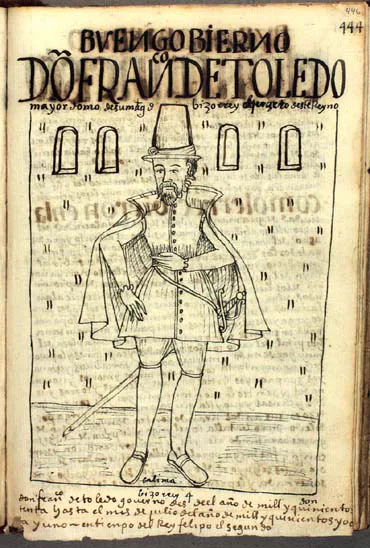
Nueva corónica y buen gobierno, dibujo 180 (p. 444 [446]) · Royal Danish Library, GKS2232 4º · gp-446
Creator: Felipe Guaman Poma de Ayala
Work date: c.1615
Retrieved: 2026-10-06
Page 446 [448] opens by blaming Toledo himself for appointing provincial corregidores “to the great harm of the Indians” (our translation).14 He accuses corregidores, parish priests, encomenderos and “other Spaniards” of robbing the Indians of “their estates, lands, houses, fields and pastures, and their wives and daughters” (our translation).15 Rule and denunciation go together in his argument: he invokes rules of government to challenge the harm he says he sees.16 The editors note that the decrees forbidding Europeans and Africans to live in Andean villages “were not complied with” (our translation).17
What link does Guaman Poma see between Andean ordinances and colonial offices?18
Guaman Poma says Toledo drew his ordinances from the ordinances of “the first Indians” (our translation).19 His explanation connects several ages of the past and lists colonial offices.20 Reading it as the author’s claim allows that relationship to be investigated without presenting one immutable Inca code transferred wholesale into Spanish administration.21
On Inca justice in the chronicle, see Inca Justice According to Guaman Poma: Officials, Inspections and Punishments.22
The editors’ note names the licenciados Juan Polo de Ondegardo and Matienzo among Toledo’s many advisers who knew the Andean world, and says these licenciados advised using pre-existing Andean and Inca institutions.23 It is useful context, not a comparison of specific provisions.24 On the resettlements, Guaman Poma writes that Toledo had the Indians “reduced and settled … some in good places, some in bad ones” (our translation), and that they were uprooted because their fields lay far away.25 The editors note that under Toledo these “mass deportations” (our translation) became frequent and cut people off from their fields, pastures and shrines.26
What does Guaman Poma hold against Toledo in Topa Amaro’s sentence?27
Guaman Poma relates that Toledo rehearsed in Cuzco, with a mock Inca, the war against Topa Amaro Ynga, who did not defend himself: he “fled, being a boy who knew nothing” (our translation).28 According to the author, Captain Martín García de Loyola went against Topa Amaro Ynga by Toledo’s order, and Topa Amaro was taken prisoner; the viceroy sentenced him to be beheaded, although the bishop of Cuzco knelt to ask for his life, together with priests, canons, conquistadors, citizens and Indian lords, and a great deal of silver was offered for it.29 The author ascribes the sentence to Toledo’s “anger” and calls him a “proud Christian” who cost the king his riches (our translation).30
According to the reconstituted act, was Santiago founded in Toledo’s time?31
Guaman Poma writes, on p. 1066 [1076], that Santiago “se edeficó” (was built) “in the time of the viceroy don Francisco de Toledo and of King Philip II” (our translation).32 Chile’s National Archive holds the reconstitution of the act dating its foundation by Pedro de Valdivia to 12 February 1541: after Michimalonco’s assault of 11 September 1541, the act was redone in 1544 from oral testimony.33 If “se edeficó” means founded, Guaman Poma’s date does not fit: the foundation the act dates to 1541 is almost three decades earlier than Toledo’s viceroyalty.34
Page 1066 [1076] praises the city and explains that the Indians of Chile, who are “warlike”, will not be subdued because “the Spaniards carry off and take all they have, wife, daughters” (our translation).35 The date is a passing mention within that description.36
On Chile, see Chile between conquest and defence: what the accounts say and what they allow us to verify.37

Credit: Felipe Guaman Poma de Ayala — Royal Danish Library, GKS 2232 4º
Rights: Public Domain Mark 1.0 (Royal Danish Library). Named-human rights admission pending.
Use in this story: Drawing from Guaman Poma’s chronicle (c. 1615), shown as a later representation and not as independent proof of the events.
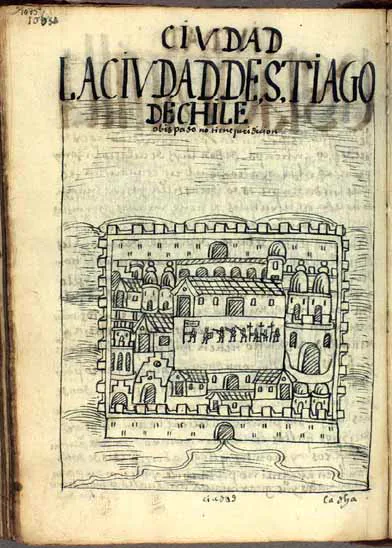
Nueva corónica y buen gobierno, dibujo 380 (p. 1065 [1075]) · Royal Danish Library, GKS2232 4º · gp-1075
Creator: Felipe Guaman Poma de Ayala
Work date: c.1615
Retrieved: 2026-10-06
How we know: we distinguish Guaman Poma’s text, his editors’ notes and the record presented by the archive.39 A date that does not fit does not erase the manuscript’s value as a criticism of government.40
How we know
Claims cited: 40 · checked against our sources: 0 · not independently fact-checked: 40.
About the sources, per our source records: Proposed claim scope only; no independent canonical substantive admission. full passage read; original paraphrase; same author as story; primary source check, not independent corroboration; Says Toledo drew his ordinances from ancient Andean ordinances and lists colonial offices. | full passage read; original paraphrase; Critical-editor chronology, not independent eyewitness testimony; Editorial note 1 dates Toledo’s viceroyalty to 1569–1581 and distinguishes earlier reductions. | full passage read; original paraphrase; Independent custodial primary-record presentation; reconstructed act, not surviving original; The archive preserves a reconstitution of the foundation act naming Pedro de Valdivia on 12 February 1541. | full surrounding passage read; original paraphrase; same author as original; not independent corroboration; Guaman criticises corregidores and abuses while describing Toledo’s ordinances: norm and alleged practice differ.
About the sources, per our source records: Proposed claim scope only; no independent canonical substantive admission. Editorial grouping title supported by the displayed entries; not an independent source proposition. full passage read; original paraphrase; Independent custodial primary-record presentation; reconstructed act, not surviving original; The archive preserves a reconstitution of the foundation act naming Pedro de Valdivia on 12 February 1541. | full passage read; original paraphrase; Critical-editor chronology, not independent eyewitness testimony; Editorial note 1 dates Toledo’s viceroyalty to 1569–1581 and distinguishes earlier reductions. | full passage read; original paraphrase; same author as story; primary source check, not independent corroboration; Assigns Santiago’s establishment to Francisco de Toledo and Philip II. | full passage read; original paraphrase; same author as story; primary source check, not independent corroboration; Says Toledo drew his ordinances from ancient Andean ordinances and lists colonial offices. | full surrounding passage read; original paraphrase; same author as original; not independent corroboration; Guaman criticises corregidores and abuses while describing Toledo’s ordinances: norm and alleged practice differ.
About the sources, per our source records: Proposed claim scope only; no independent canonical substantive admission. full passage read; original paraphrase; Independent custodial primary-record presentation; reconstructed act, not surviving original; The archive preserves a reconstitution of the foundation act naming Pedro de Valdivia on 12 February 1541.
About the sources, per our source records: Proposed claim scope only; no independent canonical substantive admission. full passage read; original paraphrase; Critical-editor chronology, not independent eyewitness testimony; Editorial note 1 dates Toledo’s viceroyalty to 1569–1581 and distinguishes earlier reductions.
About the sources, per our source records: Proposed claim scope only; no independent canonical substantive admission. full passage read; original paraphrase; same author as story; primary source check, not independent corroboration; Assigns Santiago’s establishment to Francisco de Toledo and Philip II. | full passage read; original paraphrase; same author as story; primary source check, not independent corroboration; Says Toledo drew his ordinances from ancient Andean ordinances and lists colonial offices. | full surrounding passage read; original paraphrase; same author as original; not independent corroboration; Guaman criticises corregidores and abuses while describing Toledo’s ordinances: norm and alleged practice differ.
About the sources, per our source records: Proposed claim scope only; no independent canonical substantive admission. Localized section label; support is the following section, not a source quotation. full passage read; original paraphrase; same author as story; primary source check, not independent corroboration; Says Toledo drew his ordinances from ancient Andean ordinances and lists colonial offices. | full surrounding passage read; original paraphrase; same author as original; not independent corroboration; Portrait of Toledo,444[446], with critical note correcting the vice-regal enumeration. | full surrounding passage read; original paraphrase; same author as original; not independent corroboration; Guaman criticises corregidores and abuses while describing Toledo’s ordinances: norm and alleged practice differ.
About the sources, per our source records: Proposed claim scope only; no independent canonical substantive admission. full passage read; original paraphrase; same author as story; primary source check, not independent corroboration; Says Toledo drew his ordinances from ancient Andean ordinances and lists colonial offices.
About the sources, per our source records: Proposed claim scope only; no independent canonical substantive admission. Editorial contextual-navigation sentence; destination canonical identity/publication eligibility captured read-only; not independent corroboration. full passage read; original paraphrase; same author as story; primary source check, not independent corroboration; Says Toledo drew his ordinances from ancient Andean ordinances and lists colonial offices.
About the sources, per our source records: Proposed claim scope only; no independent canonical substantive admission. Source/rights statements are supplied for human decision, not automated clearance. full surrounding passage read; original paraphrase; same author as original; not independent corroboration; Portrait of Toledo,444[446], with critical note correcting the vice-regal enumeration. | Version preparation only; actual figure/media/rights admission pending; illustration is not independent historical evidence; Caption/attribution, not reconstruction of an eyewitness scene
About the sources, per our source records: Proposed claim scope only; no independent canonical substantive admission. full passage read; original paraphrase; same author as story; primary source check, not independent corroboration; Says Toledo drew his ordinances from ancient Andean ordinances and lists colonial offices. | full surrounding passage read; original paraphrase; same author as original; not independent corroboration; Guaman criticises corregidores and abuses while describing Toledo’s ordinances: norm and alleged practice differ.
About the sources, per our source records: Proposed claim scope only; no independent canonical substantive admission. Localized section label; support is the following section, not a source quotation. full passage read; original paraphrase; same author as story; primary source check, not independent corroboration; Says Toledo drew his ordinances from ancient Andean ordinances and lists colonial offices. | full passage read; original paraphrase; Critical-editor chronology, not independent eyewitness testimony; Editorial note 1 dates Toledo’s viceroyalty to 1569–1581 and distinguishes earlier reductions. | full passage read; original paraphrase; Critical-editor contextual corroboration; Editorial note 1 names Polo de Ondegardo and Matienzo as advisers who recommended using existing Andean institutions.
About the sources, per our source records: Proposed claim scope only; no independent canonical substantive admission. full passage read; original paraphrase; Critical-editor chronology, not independent eyewitness testimony; Editorial note 1 dates Toledo’s viceroyalty to 1569–1581 and distinguishes earlier reductions. | full passage read; original paraphrase; Critical-editor contextual corroboration; Editorial note 1 names Polo de Ondegardo and Matienzo as advisers who recommended using existing Andean institutions.
About the sources, per our source records: Proposed claim scope only; no independent canonical substantive admission. Localized section label; support is the following section, not a source quotation. full passage read; original paraphrase; same author as story; primary source check, not independent corroboration; Assigns Santiago’s establishment to Francisco de Toledo and Philip II. | full passage read; original paraphrase; Critical-editor chronology, not independent eyewitness testimony; Editorial note 1 dates Toledo’s viceroyalty to 1569–1581 and distinguishes earlier reductions. | full passage read; original paraphrase; Independent custodial primary-record presentation; reconstructed act, not surviving original; The archive preserves a reconstitution of the foundation act naming Pedro de Valdivia on 12 February 1541. | full surrounding passage read; original paraphrase; same author as original; not independent corroboration; Santiago city drawing 1065[1075]; representation, not a foundation plan. | full passage read; original paraphrase; same author as story; primary source check, not independent corroboration; Says Toledo drew his ordinances from ancient Andean ordinances and lists colonial offices. | full surrounding passage read; original paraphrase; same author as original; not independent corroboration; Guaman criticises corregidores and abuses while describing Toledo’s ordinances: norm and alleged practice differ.
About the sources, per our source records: Proposed claim scope only; no independent canonical substantive admission. full passage read; original paraphrase; same author as story; primary source check, not independent corroboration; Assigns Santiago’s establishment to Francisco de Toledo and Philip II. | full passage read; original paraphrase; Critical-editor chronology, not independent eyewitness testimony; Editorial note 1 dates Toledo’s viceroyalty to 1569–1581 and distinguishes earlier reductions. | full passage read; original paraphrase; Independent custodial primary-record presentation; reconstructed act, not surviving original; The archive preserves a reconstitution of the foundation act naming Pedro de Valdivia on 12 February 1541.
About the sources, per our source records: Proposed claim scope only; no independent canonical substantive admission. Editorial contextual-navigation sentence; destination canonical identity/publication eligibility captured read-only; not independent corroboration. full passage read; original paraphrase; same author as story; primary source check, not independent corroboration; Assigns Santiago’s establishment to Francisco de Toledo and Philip II. | full passage read; original paraphrase; Critical-editor chronology, not independent eyewitness testimony; Editorial note 1 dates Toledo’s viceroyalty to 1569–1581 and distinguishes earlier reductions. | full passage read; original paraphrase; Independent custodial primary-record presentation; reconstructed act, not surviving original; The archive preserves a reconstitution of the foundation act naming Pedro de Valdivia on 12 February 1541.
About the sources, per our source records: Proposed claim scope only; no independent canonical substantive admission. Source/rights statements are supplied for human decision, not automated clearance. full surrounding passage read; original paraphrase; same author as original; not independent corroboration; Santiago city drawing 1065[1075]; representation, not a foundation plan. | Version preparation only; actual figure/media/rights admission pending; illustration is not independent historical evidence; Caption/attribution, not reconstruction of an eyewitness scene
About the sources, per our source records: Proposed claim scope only; no independent canonical substantive admission. full passage read; original paraphrase; same author as story; primary source check, not independent corroboration; Assigns Santiago’s establishment to Francisco de Toledo and Philip II. | full passage read; original paraphrase; same author as story; primary source check, not independent corroboration; Says Toledo drew his ordinances from ancient Andean ordinances and lists colonial offices. | full passage read; original paraphrase; Critical-editor chronology, not independent eyewitness testimony; Editorial note 1 dates Toledo’s viceroyalty to 1569–1581 and distinguishes earlier reductions. | full passage read; original paraphrase; Independent custodial primary-record presentation; reconstructed act, not surviving original; The archive preserves a reconstitution of the foundation act naming Pedro de Valdivia on 12 February 1541. | full surrounding passage read; original paraphrase; same author as original; not independent corroboration; Guaman criticises corregidores and abuses while describing Toledo’s ordinances: norm and alleged practice differ.
Sources
Guaman Poma presents Francisco de Toledo’s ordinances as rules that limited demands on Indigenous people.
not independently fact-checked primary source
El primer nueva corónica y buen gobierno: «Y los dichos corregidores, padres de las dotrinas, comenderos se sustentasen con sus salarios y que no tubiese tratos ni contratos en este rreyno.» p. 447 [449], text (KB digital edition)
He also denounces practices that contradicted them and condemns the viceroy’s execution of Topa Amaro Ynga.
not independently fact-checked primary source
El primer nueva corónica y buen gobierno: «Por causa del dicho corregidor, padre, comendero y demás españoles que rroban a los yndios sus haziendas y tierras y casas y sementeras y pastos y sus mugeres y hijas» p. 446 [448], text (KB digital edition)
El primer nueva corónica y buen gobierno: «Y desto ubo odio y sentenciar a muerte de enojo contra el Ynga y lo sentenció a cortalle la cauesa a Topa Amaro Ynga» p. 450 [452], text, “La captura y ejecución de Topa Amaro Ynga” (KB digital edition)
His chronology needs checking: he places Santiago’s building in Toledo’s time, but the act preserved in Chile dates its foundation to 1541.
not independently fact-checked scholarly interpretation
El primer nueva corónica y buen gobierno: «esta dicha ciudad se edeficó en tienpo del birrey don Francisco de Toledo y del rrey don Phelipe el segundo» p. 1066 [1076], text (KB digital edition)
474 años de historia de la Ciudad de Santiago: «encabezada por el español Pedro de Valdivia el 12 de febrero de 1541» “474 años de historia de la Ciudad de Santiago” (Archivo Nacional de Chile web page)
Dates to keep apart
not independently fact-checked scholarly interpretation
Archivo Nacional de Chile, 474 años de historia de la Ciudad de Santiago “474 años de historia de la Ciudad de Santiago” (Archivo Nacional de Chile web page)
Fact: 1541: Santiago founded by Pedro de Valdivia, according to an act reconstituted in 1544.
not independently fact-checked primary source
474 años de historia de la Ciudad de Santiago: «La reconstitución del acta data del 10 de enero de 1544» “474 años de historia de la Ciudad de Santiago” (Archivo Nacional de Chile web page)
Fact: 1569–1581: Toledo’s viceroyalty, according to the digital edition’s editors; Guaman Poma writes 1570 to July 1581.
not independently fact-checked primary source
Notas de los editores a la p. 445 [447] (Nueva corónica y buen gobierno, edición digital): «pero fue durante su virreinato (1569-1581) que estas deportaciones en masa se hicieron frecuentes. La gente perdía acceso tanto a sus múltiples sementeras y pastos, lugares de pesca y recolección como a sus santuarios.» p. 445 [447], editors’ note 1 (KB digital edition)
El primer nueva corónica y buen gobierno: «Don Francisco de Toledo gouernó desde el año de mill y quinientos [se]tenta hasta el mes de julio del año de mill y quinientos y oc[hen]ta y uno» Dibujo 180, p. 444 [446] (KB digital edition)
Fact: Around 1615: Guaman Poma’s manuscript, combining narrative, criticism and proposals for government.
not independently fact-checked scholarly interpretation
El primer nueva corónica y buen gobierno: «Guaman Poma, Nueva corónica y buen gobierno (1615)» p. 447 [449], text (KB digital edition)
Work and salary in Guaman Poma’s explanation
not independently fact-checked scholarly interpretation
Felipe Guaman Poma de Ayala, El primer nueva corónica y buen gobierno (2004) p. 447 [449], text (KB digital edition)
The ordinances passage says that no corregidor, parish priest, encomendero or “nengún español” (any Spaniard at all) was to put Indigenous people to any work beyond their own fields and the tribute they owed.
not independently fact-checked primary source
El primer nueva corónica y buen gobierno: «Don Francisco de Toledo mandó en sus hordenansas que los dichos corregidores ni padre de las dotrinas ni comenderos ni nengún español no les ocupasen a los pobres yndios a ningún trauajo, cino que trauajasen en sus haziendas los yndios y en su tributo lo que eran obligados.» p. 447 [449], text (KB digital edition)
Guaman Poma distinguishes work on their own holdings, tribute and community assistance from other demands.
not independently fact-checked primary source
El primer nueva corónica y buen gobierno: «trauajasen en sus sementeras y ayudasen sus comunidades» p. 447 [449], text (KB digital edition)
He adds that officials should live on their salaries rather than use office for their businesses.
not independently fact-checked primary source
El primer nueva corónica y buen gobierno: «Y los dichos corregidores, padres de las dotrinas, comenderos se sustentasen con sus salarios y que no tubiese tratos ni contratos en este rreyno.» p. 447 [449], text (KB digital edition)
The same gap between rule and abuse appears in the freedom prescribed and the abuses Las Casas and Guaman Poma denounce.
not independently fact-checked scholarly interpretation
Felipe Guaman Poma de Ayala, El primer nueva corónica y buen gobierno (2004) p. 446 [448], text (KB digital edition)
Guaman Poma, drawing 180, p. 444 [446], c. 1615: don Francisco de Toledo, labelled “bizorrey 4”, under “Buen gobierno”. The editors note that he was in fact the fifth viceroy. Royal Danish Library, GKS 2232 4º; public domain.
not independently fact-checked scholarly interpretation
El primer nueva corónica y buen gobierno: «/ en Lima / bizorrey 4 / BVEN GOBIERNO» Dibujo 180, p. 444 [446] (KB digital edition)
Notas de los editores a la p. 444 [446] (Nueva corónica y buen gobierno, edición digital): «En realidad, Toledo era el quinto virrey del Peru.» p. 444 [446], editors’ note 1 (KB digital edition)
Felipe Guaman Poma de Ayala, gp-446 (2004) toledo-portrait; exact full-frame image and supplied provenance/rights
The preceding page opens by blaming Toledo himself for appointing provincial corregidores “to the great harm of the Indians” (our translation).
not independently fact-checked primary source
El primer nueva corónica y buen gobierno: «Cómo don Francisco de Toledo dio orden de proueer corregidor de prouincias en gran daño de los yndios deste rreyno» p. 446 [448], text (KB digital edition)
He accuses corregidores, priests, encomenderos and “other Spaniards” of robbing the Indians of “their estates, lands, houses, fields and pastures, and their wives and daughters”.
not independently fact-checked primary source
El primer nueva corónica y buen gobierno: «Por causa del dicho corregidor, padre, comendero y demás españoles que rroban a los yndios sus haziendas y tierras y casas y sementeras y pastos y sus mugeres y hijas» p. 446 [448], text (KB digital edition)
Rule and denunciation go together in his argument: he invokes rules of government to challenge the harm he says he sees.
not independently fact-checked scholarly interpretation
El primer nueva corónica y buen gobierno: «Don Francisco de Toledo dexó mandado una de las santas cosas en seruicio de Dios y de su Magestad y bien de los pobres yndios, ci se guardase» p. 446 [448], text (KB digital edition)
The editors note that the decrees forbidding Europeans and Africans to live in Andean villages “were not complied with”.
not independently fact-checked primary source
Notas de los editores a la p. 446 [448] (Nueva corónica y buen gobierno, edición digital): «Desde muy temprano había cédulas que prohibían el establecimiento permanente de europeos y africanos en las aldeas andinas. Estos requisitos no se cumplieron.» p. 446 [448], editors’ note 1 (KB digital edition)
Andean institutions and colonial administration
not independently fact-checked scholarly interpretation
Felipe Guaman Poma de Ayala, El primer nueva corónica y buen gobierno (2004) p. 447 [449], text (KB digital edition)
Guaman Poma says Toledo drew provisions from ancient Andean ordinances preserved by the Incas.
not independently fact-checked primary source
El primer nueva corónica y buen gobierno: «Don Francisco de Toledo ordenó las dichas hordenansas prouado y sacado de las hordenansas de los primeros yndios» p. 447 [449], text (KB digital edition)
His explanation connects several ages of the past and lists colonial offices.
not independently fact-checked primary source
El primer nueva corónica y buen gobierno: «llamado Uari Uira Cocha Runa y de Uari Runa, Purun Runa, Auca Pacha Runa» p. 447 [449], text (KB digital edition)
Reading it as the author’s claim allows that relationship to be investigated without presenting one immutable Inca code transferred wholesale into Spanish administration.
not independently fact-checked scholarly interpretation
Felipe Guaman Poma de Ayala, El primer nueva corónica y buen gobierno (2004) p. 447 [449], text (KB digital edition)
For the Inca model Guaman Poma invokes, see Inca justice in his chronicle.
not independently fact-checked scholarly interpretation
Felipe Guaman Poma de Ayala, El primer nueva corónica y buen gobierno (2004) p. 447 [449], text (KB digital edition)
The editors’ note names Polo de Ondegardo and Juan de Matienzo, advisers who recommended using pre-existing Andean and Inca institutions.
not independently fact-checked primary source
Notas de los editores a la p. 447 [449] (Nueva corónica y buen gobierno, edición digital): «Toledo tuvo muchos consejeros conocedores del mundo andino, entre ellos los licenciados Juan Polo de Ondegardo» p. 447 [449], editors’ note 1 (KB digital edition)
It is useful context, not a comparison of specific provisions.
not independently fact-checked scholarly interpretation
John V. Murra, Rolena Adorno, Jorge L. Urioste, Notas de los editores a la p. 447 [449] (Nueva corónica y buen gobierno, edición digital) (2004) p. 447 [449], editors’ note 1 (KB digital edition)
On the resettlements, Guaman Poma writes that Toledo had the Indians “reduced and settled, some in good places, some in bad ones” (our translation), and that they were uprooted because their fields lay far away.
not independently fact-checked primary source
El primer nueva corónica y buen gobierno: «algunos en buena parte, algunos en mala parte, como la suerte cayó. Y por ello se desbarataron los yndios de su querencia por tener las sementeras muy lejos» p. 445 [447], text (KB digital edition)
The editors note that under Toledo these “mass deportations” became frequent and cut people off from their fields, pastures and shrines.
not independently fact-checked primary source
Notas de los editores a la p. 445 [447] (Nueva corónica y buen gobierno, edición digital): «pero fue durante su virreinato (1569-1581) que estas deportaciones en masa se hicieron frecuentes. La gente perdía acceso tanto a sus múltiples sementeras y pastos, lugares de pesca y recolección como a sus santuarios.» p. 445 [447], editors’ note 1 (KB digital edition)
Topa Amaro: the sentence Guaman Poma holds against Toledo
not independently fact-checked scholarly interpretation
Felipe Guaman Poma de Ayala, El primer nueva corónica y buen gobierno (2004) p. 450 [452], text, “La captura y ejecución de Topa Amaro Ynga” (KB digital edition)
Guaman Poma relates that Toledo rehearsed in Cuzco, with a mock Inca, the war against Topa Amaro Ynga, who did not defend himself: he “fled, being a boy who knew nothing” (our translation).
not independently fact-checked primary source
El primer nueva corónica y buen gobierno: «Y no fue nada ni se defendio; antes se huyó el dicho Ynga por ser muchacho y no sauer nada. Y le prendió junto al rrío solo, cin yndios.» p. 445 [447], text (KB digital edition)
Captured by Martín García de Loyola’s expedition and brought to Cuzco, he was sentenced by the viceroy to be beheaded, despite the pleas of the bishop, clergy, citizens and Indian lords, who offered silver for his life.
not independently fact-checked primary source
El primer nueva corónica y buen gobierno: «obispo de la ciudad del Cuzco, se hincó de rrodillas ante el birrey don Francisco de Toledo y pidió la uida de Topa Amaro» p. 450 [452], text, “La captura y ejecución de Topa Amaro Ynga” (KB digital edition)
The author ascribes the sentence to Toledo’s “anger” and calls him a “proud Christian” who cost the king his riches (our translation).
not independently fact-checked primary source
El primer nueva corónica y buen gobierno: «Y desto ubo odio y sentenciar a muerte de enojo contra el Ynga y lo sentenció a cortalle la cauesa a Topa Amaro Ynga» p. 450 [452], text, “La captura y ejecución de Topa Amaro Ynga” (KB digital edition)
Santiago was not founded during that viceroyalty
not independently fact-checked scholarly interpretation
Archivo Nacional de Chile, 474 años de historia de la Ciudad de Santiago “474 años de historia de la Ciudad de Santiago” (Archivo Nacional de Chile web page)
Guaman Poma writes that Santiago “se edeficó” (was built) “in the time of the viceroy don Francisco de Toledo and of King Philip II”.
not independently fact-checked primary source
El primer nueva corónica y buen gobierno: «esta dicha ciudad se edeficó en tienpo del birrey don Francisco de Toledo y del rrey don Phelipe el segundo» p. 1066 [1076], text (KB digital edition)
Chile’s National Archive holds the reconstitution of the act dating its foundation by Pedro de Valdivia to 12 February 1541: the original burned in Michimalonco’s assault in September 1541 and was redone in 1544 from testimony.
not independently fact-checked primary source
474 años de historia de la Ciudad de Santiago: «sobre la base de los testimonios orales de los participantes en este acto fundacional» “474 años de historia de la Ciudad de Santiago” (Archivo Nacional de Chile web page)
If “was built” means founded, Guaman Poma’s date does not fit: the act is almost three decades older than Toledo’s viceroyalty.
not independently fact-checked scholarly interpretation
El primer nueva corónica y buen gobierno: «esta dicha ciudad se edeficó en tienpo del birrey don Francisco de Toledo y del rrey don Phelipe el segundo» p. 1066 [1076], text (KB digital edition)
474 años de historia de la Ciudad de Santiago: «encabezada por el español Pedro de Valdivia el 12 de febrero de 1541» “474 años de historia de la Ciudad de Santiago” (Archivo Nacional de Chile web page)
El primer nueva corónica y buen gobierno: «Don Francisco de Toledo gouernó desde el año de mill y quinientos [se]tenta hasta el mes de julio del año de mill y quinientos y oc[hen]ta y uno» Dibujo 180, p. 444 [446] (KB digital edition)
The page is not about the foundation: it praises the land of Chile and explains that its “warlike” Indians will not be subdued because “the Spaniards carry off and take all they have, wife, daughters” (our translation).
not independently fact-checked primary source
El primer nueva corónica y buen gobierno: «pero belicosos yndios brabícimos. No se dejan uenzer por uer que los españoles arrea y quita quanto tiene, muger, hijas, a los yndios deste rreyno» p. 1066 [1076], text (KB digital edition)
The date is a passing mention within that description.
not independently fact-checked scholarly interpretation
Felipe Guaman Poma de Ayala, El primer nueva corónica y buen gobierno (2004) p. 1066 [1076], text (KB digital edition)
Other pages by the same author on Chile are examined in Chile in Guaman Poma’s chronicle.
not independently fact-checked scholarly interpretation
Felipe Guaman Poma de Ayala, El primer nueva corónica y buen gobierno (2004) p. 1066 [1076], text (KB digital edition)
Guaman Poma, drawing 380, p. 1065 [1075], c. 1615: the city of Santiago de Chile, “obispado” (bishopric). A later representation of the city, not a foundation plan. Royal Danish Library, GKS 2232 4º; public domain.
not independently fact-checked scholarly interpretation
El primer nueva corónica y buen gobierno: «Dibujo 380. La ciudad de Santiago de Chile, obispado» Dibujo 380, p. 1065 [1075] (KB digital edition)
Felipe Guaman Poma de Ayala, gp-1075 (2004) santiago-drawing; exact full-frame image and supplied provenance/rights
How we know: we distinguish Guaman Poma’s text, his editors’ notes and the record presented by the archive.
not independently fact-checked scholarly interpretation
Felipe Guaman Poma de Ayala, El primer nueva corónica y buen gobierno (2004) p. 447 [449], text (KB digital edition)
John V. Murra, Rolena Adorno, Jorge L. Urioste, Notas de los editores a la p. 445 [447] (Nueva corónica y buen gobierno, edición digital) (2004) p. 445 [447], editors’ note 1 (KB digital edition)
Archivo Nacional de Chile, 474 años de historia de la Ciudad de Santiago “474 años de historia de la Ciudad de Santiago” (Archivo Nacional de Chile web page)
A date that does not fit does not erase the manuscript’s value as a criticism of government.
not independently fact-checked scholarly interpretation
Felipe Guaman Poma de Ayala, El primer nueva corónica y buen gobierno (2004) p. 446 [448], text (KB digital edition)
leyenda-dorada · https://leyendadorada.com/en/stories/francisco-de-toledo-ordinances-guaman-poma · accessed November 22, 2026